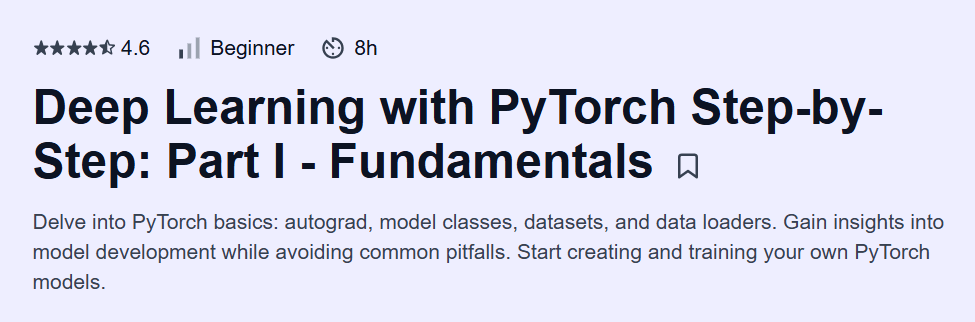
What will you learn in Deep Learning with PyTorch Step-by-Step: Part I – Fundamentals Course
-
Understand the principles of deep learning and why PyTorch is widely used
-
Manipulate tensors, compute gradients, and leverage automatic differentiation
-
Build custom neural network architectures using
nn.Moduleandtorchvision
-
Train, validate, and tune models with optimizers, loss functions, and learning rate schedules
-
Apply convolutional and recurrent networks for computer vision and sequence tasks
-
Deploy trained models and follow best practices for reproducibility and performance
Program Overview
Module 1: Introduction to PyTorch & Deep Learning
⏳ 1 week
-
Topics: Deep learning fundamentals, PyTorch ecosystem, CPU vs. GPU execution
-
Hands-on: Install PyTorch, run a “Hello, World!” tensor example, and visualize operations
Module 2: Tensors, Autograd & Computation Graphs
⏳ 1 week
-
Topics: Tensor operations, broadcasting, gradient tracking, computational graphs
-
Hands-on: Compute gradients for simple functions and implement a manual optimizer
Module 3: Building Neural Networks with nn.Module
⏳ 1 week
-
Topics: Layers, activations, model definitions, forward/backward methods
-
Hands-on: Define and train a feedforward network on MNIST classification
Module 4: Training Loop, Loss & Optimization
⏳ 1 week
-
Topics: Loss functions (CrossEntropy, MSE), optimizers (SGD, Adam), batching, and epochs
-
Hands-on: Write a full training and validation loop, plot loss and accuracy curves
Module 5: Convolutional Neural Networks & Transfer Learning
⏳ 1 week
-
Topics: Conv layers, pooling, pretrained models, fine-tuning strategies
-
Hands-on: Build a CNN for CIFAR-10, then fine-tune ResNet on a custom image dataset
Module 6: Recurrent Networks & Sequence Modeling
⏳ 1 week
-
Topics: RNN, LSTM, GRU cells, sequence-to-sequence basics, teacher forcing
-
Hands-on: Implement a character-level language model and generate text samples
Module 7: Model Deployment & Best Practices
⏳ 1 week
-
Topics: Saving/loading models, TorchScript, ONNX export, reproducibility tips
-
Hands-on: Export a trained model to TorchScript and run inference in a standalone script
Module 8: Capstone Project – End-to-End Deep Learning
⏳ 1 week
-
Topics: Project scoping, data pipelines, evaluation metrics, presentation
-
Hands-on: Tackle a real-world problem—e.g., image segmentation or sentiment analysis—and present results
Get certificate
Job Outlook
-
Deep learning with PyTorch is in high demand for roles like ML Engineer, Research Scientist, and AI Developer
-
Industries include healthcare imaging, autonomous vehicles, NLP-driven services, and recommendation systems
-
Salaries for entry-level positions start around $90,000, rising to $150,000+ for experienced practitioners
-
Mastery of PyTorch fundamentals opens paths to advanced research and specialized AI roles
Explore More Learning Paths
Advance your deep learning and AI skills with these hand-picked courses designed to help you master neural networks, PyTorch, and real-world machine learning applications.
Related Courses
-
Deep Learning Specialization Course – Gain a comprehensive understanding of deep learning, including neural networks, CNNs, RNNs, and practical AI applications.
-
DeepLearning.AI Data Engineering Professional Certificate Course – Learn to engineer data pipelines and prepare datasets to train high-performance deep learning models.
-
Neural Networks and Deep Learning Course – Build and train neural networks while understanding the fundamentals of deep learning algorithms.
Related Reading
-
What Is Data Management? – Discover how effective data management practices are crucial for training, deploying, and scaling deep learning models efficiently.