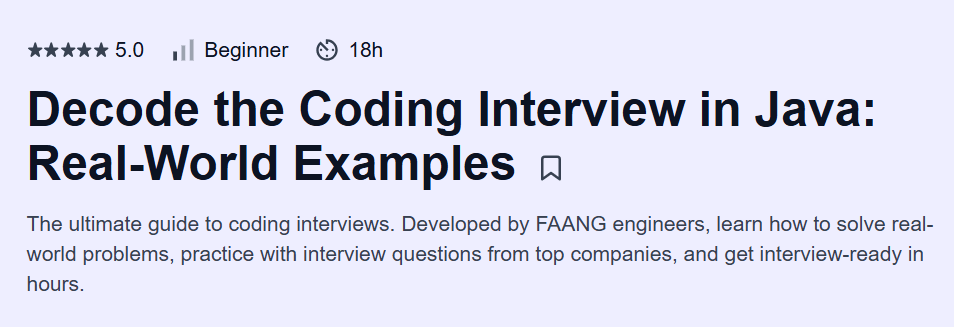
What will you learn in Decode the Coding Interview in Java: Real-World Examples Course
-
Master essential Java data structures and algorithms for coding interviews
-
Understand time and space complexity and Big O analysis
-
Apply problem-solving patterns (two pointers, sliding window, recursion) in Java
-
Practice coding clean, optimized solutions to arrays, strings, trees, graphs, and DP challenges
-
Gain confidence for technical interviews at top tech companies
Program Overview
Module 1: Java Foundations & Problem Solving
⏳ 1 week
-
Topics: Java syntax refresher, collections framework, complexity analysis
-
Hands-on: Implement basic algorithms (sorting, searching) and analyze their performance
Module 2: Arrays & Strings
⏳ 1 week
-
Topics: Two-pointer, sliding window, frequency counting
-
Hands-on: Solve “Longest Substring Without Repeating Characters” and “Array Pair Sum” problems
Module 3: Linked Lists & Stacks/Queues
⏳ 1 week
-
Topics: Singly/doubly linked lists, stack/queue operations using
Deque -
Hands-on: Implement “Reverse Linked List” and “Valid Parentheses” in Java
Module 4: Trees & Graphs
⏳ 1 week
-
Topics: Binary tree traversals, BST operations, BFS/DFS on graphs
-
Hands-on: Code “Lowest Common Ancestor” and “Graph Cycle Detection”
Module 5: Recursion & Backtracking
⏳ 1 week
-
Topics: Recursive patterns, call stack, pruning, backtracking techniques
-
Hands-on: Tackle “N-Queens” and “Permutations” with Java recursion
Module 6: Dynamic Programming & Greedy
⏳ 1 week
-
Topics: Memoization vs. tabulation, greedy strategy patterns
-
Hands-on: Solve “Coin Change” and “Longest Increasing Subsequence”
Module 7: Mock Interviews & Optimization
⏳ 1 week
-
Topics: Interview etiquette, code optimization, space/time trade-offs
-
Hands-on: Conduct timed mock interviews with real Java questions
Module 8: Capstone Challenge
⏳ 1 week
-
Topics: End-to-end interview simulation, system design primer
-
Hands-on: Complete a full-length, multi-problem coding interview in Java
Get certificate
Job Outlook
-
Strong DSA skills in Java are critical for roles at FAANG and other tech leaders
-
Positions include Software Engineer, Backend Developer, and SDET
-
Salaries range from $100,000 to $180,000+ based on company and location
-
Mastery of these topics vastly improves placement and promotion prospects
Explore More Learning Paths
Take your engineering and management expertise to the next level with these hand-picked programs designed to expand your skills and boost your leadership potential.
Related Courses
-
Parallel Programming in Java Course – Strengthen your Java skills by learning to build efficient, multithreaded, and parallelized applications for real-world performance challenges.
-
IBM Java Developer Professional Certificate Course – Become a job-ready Java developer with comprehensive training in Java fundamentals, cloud-native development, microservices, and industry tools.
-
Object-Oriented Programming in Java Course – Master the core principles of OOP in Java to design clean, modular, and scalable software applications.
Related Reading
Gain deeper insight into how project management drives real-world success:
-
What Is Project Management? – Understand the principles that make every great project a success story.