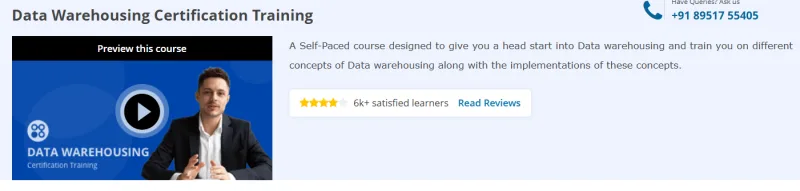
What will you learn in Data Warehousing Certification Training Course
-
Grasp core data warehousing concepts: subject orientation, time variance, and integration.
-
Design and implement dimensional models using star and snowflake schemas.
-
Handle Slowly Changing Dimensions (Types I–III) and maintain historical data.
-
Build end-to-end ETL pipelines with Talend, including extraction, transformation, and load.
-
Model data with ERWin and generate metadata for reporting.
-
Create BI dashboards and visualizations in Tableau to derive insights.
Program Overview
Module 1: Data Warehouse Fundamentals
⏳ 3 hours
-
Topics: OLTP vs. OLAP, Data Marts, Operational Data Store, warehouse architecture.
-
Hands-on: Sketch your own warehouse architecture and identify key components.
Module 2: Dimensional Modeling & SCD
⏳ 4 hours
-
Topics: Fact vs. dimension tables, hierarchies, star and snowflake schemas, Slowly Changing Dimensions.
-
Hands-on: Model a customer sales schema and implement SCD Type II in ERWin.
Module 3: Normalization & Schema Design
⏳ 3 hours
-
Topics: Normal forms, galaxy schemas, metadata management.
-
Hands-on: Normalize a sample dataset and map to appropriate schema types.
Module 4: ETL Development with Talend
⏳ 6 hours
-
Topics: Talend components, data extraction, transformation functions, job orchestration.
-
Hands-on: Build a Talend job to ingest CSV and database sources into staging.
Module 5: BI Visualization with Tableau
⏳ 5 hours
-
Topics: Connecting Tableau to warehouses, building dashboards, filters, calculated fields.
-
Hands-on: Create interactive dashboards tracking sales trends and KPIs.
Module 6: Capstone Project
⏳ 4 hours
-
Topics: End-to-end pipeline orchestration, from source ingestion to dashboard delivery.
-
Hands-on: Deliver a complete mini-project: ingest raw data, model it, load into warehouse, and build a Tableau dashboard.
Get certificate
Job Outlook
-
Data engineers, ETL developers, and BI analysts command salaries from $90K–$130K USD.
-
Expertise spans industries: finance, healthcare, retail, and tech.
-
Skills in Talend, ERWin, and Tableau are highly sought after for enterprise analytics roles.
-
Career paths include Data Architect, Analytics Engineer, and BI Consultant.
Explore More Learning Paths
Enhance your data management and analytics expertise with these carefully selected courses designed to help you master data warehousing, cloud-based solutions, and practical data engineering skills.
Related Courses
-
Modernizing Data Lakes and Data Warehouses with Google Cloud – Learn how to design and optimize modern cloud-based data storage solutions for scalable analytics.
-
IBM Data Warehouse Engineer Professional Certificate Course – Gain practical skills in building, managing, and optimizing data warehouses for enterprise-level applications.
-
Data Warehouse Fundamentals for Beginners Course – Understand the basics of data warehousing and how to structure data for analysis and reporting.
Related Reading
-
What Is Data Management – Learn how proper data management underpins efficient data warehousing, analytics, and decision-making processes.