9.6/10
Highly Recommended
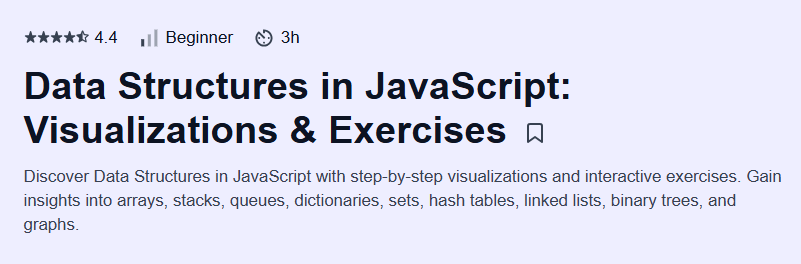
Data Structures in JavaScript: Visualizations & Exercises Course on Educative — This interactive course demystifies data structures through clear, step-by-step visualizations and immediate coding practice.
Pros
- Visual, interactive lessons make abstract concepts tangible
- Hands-on exercises reinforce learning with immediate feedback
- Compact 3-hour format suits busy schedules
Cons
- Lacks deeper coverage of advanced algorithms (e.g., graph traversal optimizations)
- No video lectures—text-based with embedded visuals only
Data Structures in JavaScript: Visualizations & Exercises Course Course
Platform: Educative
Instructor: Developed by MAANG Engineers
What will you learn in Data Structures in JavaScript: Visualizations & Exercises Course
-
Work with core data structures in JavaScript: Arrays, Stacks, and Queues
-
Manipulate Sets and Dictionaries with efficient lookups
Program Overview
Module 1: Data Structures Overview
⏳ 3 hours
-
Topics: Arrays, Stacks, Queues, Sets, Dictionary, Hash Table, Linked List, Binary Tree, Binary Search Tree, Graphs
-
Hands-on: Interactive visualizations and coding exercises for each structure
Module 2: Course Assessment
⏳ —
Job Outlook
-
Work with core data structures in JavaScript: Arrays, Stacks, and Queues
-
Manipulate Sets and Dictionaries with efficient lookups
-
Implement Hash Tables for constant-time insertions and deletions
-
Build and traverse Linked Lists for dynamic data storage
Explore More Learning Paths
Strengthen your programming and algorithmic skills with these carefully selected courses designed to help you master data structures, visualize data, and improve problem-solving in JavaScript and Python.
Related Courses
Related Reading
FAQs
Can learning JavaScript data structures help in competitive programming?
Core data structures like arrays, stacks, and queues are frequently used in coding contests. Understanding hash tables and sets helps in optimizing search and lookup operations. Linked lists and trees are essential for dynamic and hierarchical problems. Hands-on exercises reinforce memory and retrieval logic needed for competitions. Knowledge from this course speeds up solution development in timed challenges.
How can I visualize custom data structures using JavaScript?
Libraries like D3.js or Chart.js allow custom visual representations. DOM manipulation can create interactive visual demos of any structure. Animations can show operations like insertion, deletion, and traversal. Enhances understanding and debugging of complex algorithms. Useful for teaching or sharing algorithm concepts visually.
Can these JavaScript data structures integrate with backend databases?
Arrays and objects can be serialized into JSON for database storage. Hash maps and dictionaries map naturally to key-value stores like Redis. Trees and graphs can represent hierarchical or relational data. Efficient data handling in-memory reduces load on the database. Knowledge improves performance tuning for full-stack applications.
How does understanding data structures improve debugging skills?
Recognizing the underlying structure helps trace logical errors faster. Visualizations aid in spotting incorrect insertions or deletions. Understanding traversal patterns improves detection of loop or recursion issues. Efficient structure choice can prevent memory or performance bugs. Enhances ability to optimize algorithms for real-world projects.
What career advantages does mastering JavaScript data structures offer?
Improves employability as a frontend or full-stack developer. Essential for technical interviews and coding challenges at top tech companies. Helps in building performant web applications with dynamic data. Opens paths to roles in algorithm design, game development, or analytics. Provides a strong foundation for advanced topics like AI, ML, and backend optimization.