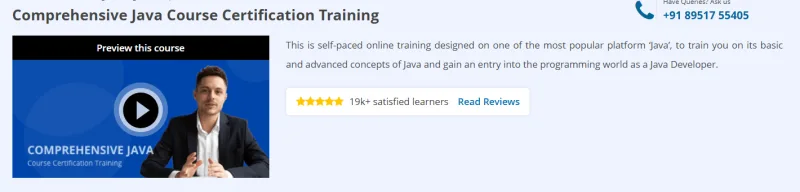
What will you learn in Comprehensive Java Course Certification Training Course
-
Master core Java SE fundamentals: syntax, data types, control structures, and object-oriented principles (classes, inheritance, polymorphism, interfaces)
-
Work with Java Collections Framework:
List,Set,Map, generics, and stream-based functional operations -
Handle exceptions, perform file I/O with NIO, and manage logging with
java.util.loggingor SLF4J
-
Build multi-threaded applications using
Thread,ExecutorService, synchronization, and concurrency utilities -
Persist data with JDBC and ORM frameworks like Hibernate, and develop RESTful services with Spring Boot
Program Overview
Module 1: Java Basics & OOP
⏳ 1 week
-
Topics: JDK setup,
javac/javacommands, variables, operators, control flow, methods -
Hands-on: Write console apps: calculators, palindrome checks, and simple class hierarchies
Module 2: Classes, Objects & Inheritance
⏳ 1 week
-
Topics: Constructors,
this/super, method overloading/overriding, abstract classes, interfaces -
Hands-on: Model a small domain (e.g., vehicle hierarchy) and demonstrate polymorphic behavior
Module 3: Collections & Generics
⏳ 1 week
-
Topics:
List,Set,Map, iterators,Comparable/Comparator, generics basics -
Hands-on: Implement data-processing tasks (sorting, filtering) using Collections and Streams
Module 4: Exception Handling & I/O
⏳ 1 week
-
Topics: Checked vs. unchecked exceptions, try-with-resources, File I/O (
java.io& NIO) -
Hands-on: Build a file-processor to read, transform, and write CSV/text data safely
Module 5: Concurrency & Multithreading
⏳ 1 week
-
Topics:
Threadvs.Runnable, thread lifecycle, synchronization, concurrent collections,ExecutorService -
Hands-on: Develop a multi-threaded downloader or task-executor to illustrate race conditions and locks
Module 6: JDBC & Database Interaction
⏳ 1 week
-
Topics: JDBC API, connection pooling, transactions, CRUD operations, SQL injection prevention
-
Hands-on: Create a simple CLI app to manage customer records in a relational database
Module 7: Spring Boot & RESTful Services
⏳ 1 week
-
Topics: Spring Core DI, Spring MVC, REST controllers, request/response handling, error handling
-
Hands-on: Build and test a RESTful API for the earlier JDBC app, exposing JSON endpoints
Module 8: Hibernate & ORM
⏳ 1 week
-
Topics: JPA annotations, entity relationships (one-to-many, many-to-many), lazy vs. eager loading
-
Hands-on: Migrate JDBC code to use Hibernate entities and repositories for data access
Module 9: Build Tools, Testing & Debugging
⏳ 1 week
-
Topics: Maven/Gradle project structure, dependency scopes, JUnit/TestNG basics, debugging techniques
-
Hands-on: Set up a Maven project, write unit/integration tests, and step-through code in an IDE
Module 10: Capstone Project – Full-Stack Java App
⏳ 2 weeks
-
Topics: Project planning, layering (controller, service, repository), security basics with Spring Security
-
Hands-on: Deliver a complete Java web application with a database backend, REST API, and a simple web UI or client
Get certificate
Job Outlook
-
Java Developer: $80,000–$120,000/year — build enterprise and web applications using Java technologies
-
Backend Engineer: $85,000–$130,000/year — design and maintain APIs and microservices with Spring Boot
-
Full-Stack Java Developer: $90,000–$140,000/year — integrate front-end frameworks (e.g., Angular/React) with Java back ends
-
Java remains one of the top in-demand languages across finance, e-commerce, and enterprise sectors.
Explore More Learning Paths
Advance your Java expertise with these hand-selected programs designed to deepen your programming knowledge, enhance your object-oriented skills, and prepare you for real-world software development roles.
Related Courses
-
AI Agents in Java with Generative AI Specialization Course – Learn how to build modern AI-powered agents using Java, integrating generative AI capabilities into practical applications.
-
IBM Java Developer Professional Certificate Course – Gain job-ready Java development skills with training in OOP, APIs, microservices, and cloud-native technologies.
-
Object-Oriented Programming in Java Course – Strengthen your understanding of core OOP principles and learn how to apply them effectively in Java development.
Related Reading
Enhance your understanding of how structured processes improve software engineering and development:
-
What Is Operations Management? – Discover how efficient workflows and resource planning support successful software projects and engineering teams