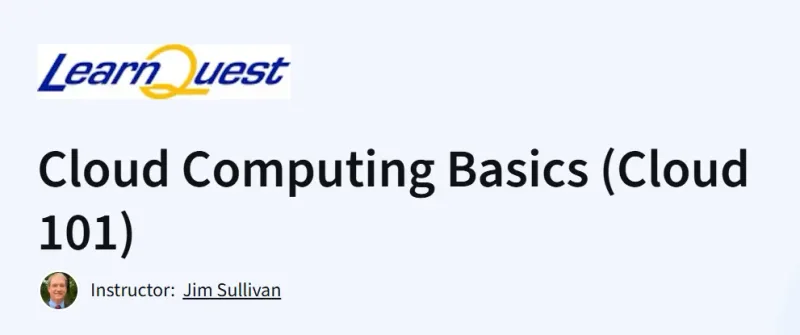
What will you learn in Cloud Computing Basics (Cloud 101) Course
- This course provides a foundational understanding of cloud computing concepts and services.
- Learners will understand the core cloud service models including IaaS, PaaS, and SaaS.
- The course emphasizes virtualization, distributed systems, and scalability principles.
- Students will explore public, private, and hybrid cloud deployment models.
- Real-world examples demonstrate how organizations leverage cloud infrastructure for cost efficiency and flexibility.
- By the end of the course, participants will gain essential knowledge required to pursue cloud certifications and IT careers.
Program Overview
Introduction to Cloud Computing
⏳ 2–3 Weeks
- Understand what cloud computing is and why it matters.
- Learn about data centers and virtualization.
- Explore elasticity and scalability concepts.
- Study cloud evolution and industry adoption.
Cloud Service Models
⏳ 2–3 Weeks
- Differentiate between IaaS, PaaS, and SaaS.
- Understand shared responsibility models.
- Explore real-world service examples.
- Analyze cost and performance trade-offs.
Cloud Deployment Models
⏳ 2–3 Weeks
- Study public, private, and hybrid clouds.
- Understand multi-cloud strategies.
- Learn about cloud migration basics.
- Explore security considerations.
Cloud Applications and Future Trends
⏳ 2–3 Weeks
- Explore big data and AI integration with cloud.
- Understand serverless computing fundamentals.
- Learn about edge computing concepts.
- Analyze emerging cloud technologies.
Get certificate
Job Outlook
- Cloud computing is one of the fastest-growing areas in IT, with demand across technology, finance, healthcare, retail, and government sectors.
- Professionals with cloud knowledge are sought for roles such as Cloud Support Specialist, Cloud Engineer, Systems Administrator, and DevOps Engineer.
- Entry-level cloud professionals typically earn between $75K–$100K per year, while experienced cloud architects and engineers can earn $120K–$170K+ depending on specialization and region.
- Cloud skills also serve as a foundation for cybersecurity, AI, and data engineering careers.
- This course provides an excellent starting point for certifications from providers such as AWS, Microsoft Azure, and Google Cloud.