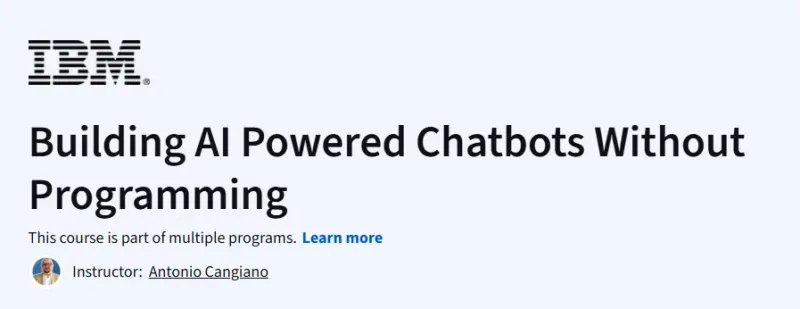
What will you learn in Building AI Powered Chatbots Without Programming Course
-
Design conversational flows and user intents for AI-powered chatbots.
-
Integrate Large Language Models (e.g., OpenAI GPT) into chatbot backends.
-
Implement rich messaging features—buttons, carousels, and multimedia responses.
-
Deploy chatbots to multiple channels: web, mobile, and messaging platforms (Slack, WhatsApp).
-
Handle context, session management, and multi-turn conversations effectively.
Program Overview
Module 1: Introduction to AI Chatbots & Architecture
⏳ 1.5 hours
-
Topics: Evolution of chatbots, LLM basics, system architecture.
-
Hands-on: Sketch a high-level architecture for an AI chatbot using GPT APIs.
Module 2: Intent Recognition & Slot Filling
⏳ 2 hours
-
Topics: NLU concepts, training intent classifiers, extracting entities.
-
Hands-on: Build and evaluate an intent classifier; implement slot-filling logic.
Module 3: Conversational Flow Design
⏳ 2 hours
-
Topics: Dialogue state management, decision trees vs. generative approaches.
-
Hands-on: Create multi-turn flows with context variables in a chatbot framework.
Module 4: Integrating LLMs into Your Bot
⏳ 2 hours
-
Topics: Calling GPT/OpenAI APIs, prompt engineering, handling API responses.
-
Hands-on: Implement a middleware that formats user inputs into prompts and parses outputs.
Module 5: Rich Messaging & UI Components
⏳ 1.5 hours
-
Topics: Quick replies, carousels, buttons, images, and attachments.
-
Hands-on: Enhance your bot’s responses with interactive UI elements.
Module 6: Multi-Channel Deployment
⏳ 2 hours
-
Topics: Connecting to Slack, WhatsApp, and web chat widgets.
-
Hands-on: Deploy your chatbot to Slack and test real-time interactions.
Module 7: Testing, Analytics & Optimization
⏳ 1.5 hours
-
Topics: Unit testing, conversational QA, user metrics tracking, A/B testing.
-
Hands-on: Set up analytics dashboards and run a conversation-flow experiment.
Module 8: Security, Privacy & Compliance
⏳ 1 hour
-
Topics: Data handling, GDPR/CCPA considerations, input sanitization.
-
Hands-on: Implement logging and consent management for user data.
Get certificate
Job Outlook
-
AI chatbot developers and conversational UX designers are in high demand across e-commerce, customer support, and enterprise automation.
-
Roles include Conversational AI Engineer, Bot Developer, and Chatbot UX Specialist, with salaries ranging $90K–$130K USD.
-
Skills in LLM integration, prompt engineering, and multi-channel deployment open opportunities in startups and large tech firms.
Explore More Learning Paths
Expand your AI and chatbot development skills with these targeted courses designed to help you build intelligent applications without prior programming experience.
Related Courses
-
AI Agent Developer Specialization Course – Learn to design, develop, and deploy AI agents for real-world applications using intuitive tools and platforms.
-
Google Gemini for Beginners: From Basics to Building AI Apps Course – Master Google Gemini tools to create AI-powered apps, from basic concepts to functional AI solutions.
-
Mastering LlamaIndex: From Fundamentals to Building AI Apps Course – Gain hands-on experience building AI applications using LlamaIndex, with step-by-step guidance for beginners.
Related Reading
Gain deeper insight into managing knowledge and AI applications effectively:
-
What Is Knowledge Management? – Explore how knowledge management practices support AI development by organizing, sharing, and leveraging information efficiently.