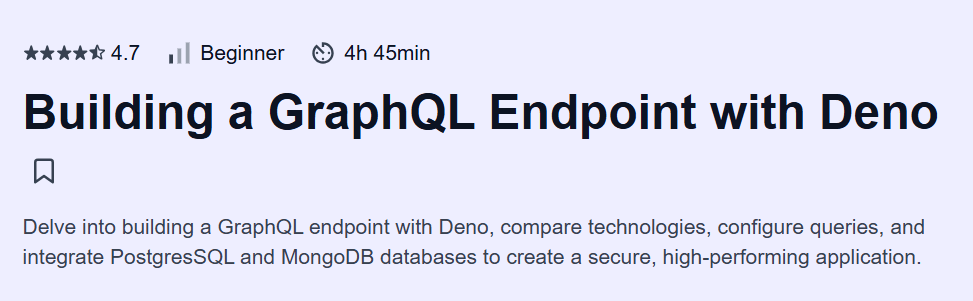
What will you learn in Building a GraphQL Endpoint with Deno Course
-
Understand Deno’s secure, modern runtime and its built-in TypeScript support for server development
-
Grasp GraphQL fundamentals and schema design: types, queries, mutations, and resolvers
-
Create a Deno HTTP server and integrate a GraphQL endpoint using community modules (e.g.,
oak+gql)
-
Connect your GraphQL API to both SQL (PostgreSQL) and NoSQL (MongoDB) databases for flexible data persistence
-
Develop and test GraphQL queries and mutations with tooling like GraphQL Playground and automated tests
-
Package and deploy your Deno-based GraphQL service, leveraging Docker and environment-based configuration
Program Overview
Module 1: Introduction to Deno, TypeScript & GraphQL
⏳ 30 minutes
-
Topics: What is Deno? Benefits over Node.js, built-in TypeScript support, GraphQL basics
-
Hands-on: Install Deno, run a “Hello, GraphQL” example, explore GraphQL Playground
Module 2: Setting Up Your Deno GraphQL Server
⏳ 45 minutes
-
Topics: HTTP frameworks for Deno (
oak), GraphQL middleware (oak-graphqlorgql) -
Hands-on: Create a basic
/graphqlendpoint that responds to simple queries
Module 3: Schema Design & Resolver Implementation
⏳ 1 hour
-
Topics: Defining type definitions, query and mutation structures, resolver functions
-
Hands-on: Implement a
Usertype withcreateUser,getUser, andlistUsersoperations
Module 4: Integrating PostgreSQL with Deno
⏳ 45 minutes
-
Topics: SQL vs. NoSQL considerations, Deno Postgres client setup, schema migrations
-
Hands-on: Connect to PostgreSQL, define tables, and wire resolvers to perform CRUD via SQL
Module 5: Integrating MongoDB with Deno
⏳ 45 minutes
-
Topics: MongoDB driver for Deno, document modeling, collections vs. tables
-
Hands-on: Configure a MongoDB connection, define a
Postcollection, and implement GraphQL resolvers for it
Module 6: Testing & Tooling
⏳ 30 minutes
-
Topics: Writing unit tests for resolvers, using GraphQL Playground, linting and formatting
-
Hands-on: Write tests for query/mutation logic and validate schema correctness
Module 7: Deployment & Dockerization
⏳ 30 minutes
-
Topics: Dockerfile for Deno, multi-stage builds, environment variables, Deno Deploy overview
-
Hands-on: Containerize your GraphQL service and run it via Docker Compose with linked databases
Module 8: Capstone – Feature Extension & Best Practices
⏳ 30 minutes
-
Topics: Authentication with JWT, pagination, batching, error handling, rate limits
-
Hands-on: Add a
loginmutation with JWT issuance and secure your GraphQL endpoint
Get certificate
Job Outlook
-
Backend Engineer (Deno/GraphQL): $95,000–$140,000/year — build high-performance API services with modern runtimes
-
Full-Stack JavaScript/TypeScript Developer: $90,000–$130,000/year — leverage GraphQL and Deno for end-to-end web applications
-
API Architect / Developer Advocate: $100,000–$150,000/year — design and document GraphQL schemas and champion Deno adoption
-
Skills in Deno and GraphQL position you at the forefront of server-side development, enabling you to craft secure, type-safe, and efficient APIs.
Explore More Learning Paths
Take your backend development and API design expertise to the next level with these hand-picked programs designed to deepen your understanding of GraphQL and modern web technologies.
Related Courses
-
The Modern GraphQL Bootcamp with Node.js and Apollo Course – Learn to build scalable GraphQL APIs, integrate with Node.js, and use Apollo for efficient client-server communication.
Related Reading
Gain deeper insight into how structured knowledge drives effective backend development:
-
What Is Knowledge Management? – Explore how organizing and leveraging information supports efficient API design, development workflows, and team collaboration.