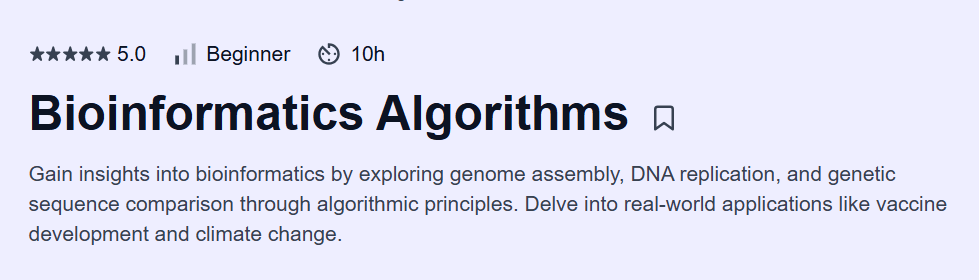
What will you learn in Bioinformatics Algorithms Course
-
Grasp fundamental bioinformatics algorithms for sequence analysis, alignment, and assembly
-
Implement dynamic programming approaches: Needleman–Wunsch, Smith–Waterman, and BLAST heuristics
-
Understand graph-based methods for genome assembly (de Bruijn graphs) and variation detection
-
Apply probabilistic models: hidden Markov models for gene prediction and profile HMMs for protein families
-
Leverage optimization techniques for multiple sequence alignment and phylogenetic tree reconstruction
Program Overview
Module 1: Introduction to Bioinformatics & Sequence Data
⏳ 1 week
-
Topics: Biological sequence formats (FASTA, FASTQ), scoring matrices (PAM, BLOSUM)
-
Hands-on: Parse real DNA/RNA FASTA files and compute simple similarity scores
Module 2: Pairwise Alignment with Dynamic Programming
⏳ 1 week
-
Topics: Global alignment (Needleman–Wunsch), local alignment (Smith–Waterman), affine gap penalties
-
Hands-on: Implement both algorithms in Python and align sample protein sequences
Module 3: Heuristic Alignment & BLAST
⏳ 1 week
-
Topics: BLAST algorithm overview, word-size seeding, high-scoring segment pairs (HSPs)
-
Hands-on: Use Biopython to run and parse BLAST searches against a small custom database
Module 4: Multiple Sequence Alignment
⏳ 1 week
-
Topics: Progressive alignment (ClustalW), iterative refinement, consistency-based methods
-
Hands-on: Align a set of homologous protein sequences and visualize conserved motifs
Module 5: Genome Assembly Algorithms
⏳ 1 week
-
Topics: Overlap–layout–consensus vs. de Bruijn graph approaches, error correction basics
-
Hands-on: Build a de Bruijn graph from simulated reads and extract contigs
Module 6: Hidden Markov Models in Bioinformatics
⏳ 1 week
-
Topics: HMM components, Viterbi and forward–backward algorithms, profile HMMs for domain detection
-
Hands-on: Train a simple HMM for gene prediction on toy bacterial sequences
Module 7: Phylogenetic Inference & Tree Reconstruction
⏳ 1 week
-
Topics: Distance-based (UPGMA, neighbor-joining) and character-based (maximum parsimony, maximum likelihood) methods
-
Hands-on: Construct and compare phylogenetic trees from aligned sequences using scikit-bio
Module 8: Advanced Topics & Capstone Project
⏳ 1 week
-
Topics: Sequence clustering, variant calling basics, scalable algorithms for big data
-
Hands-on: End-to-end mini-project: annotate a draft bacterial genome with gene models and variant sites
Get certificate
Job Outlook
-
Bioinformatics algorithm expertise is in demand in genomics research, pharmaceutical R&D, and biotech startups
-
Roles include Bioinformatics Scientist, Computational Biologist, Genomics Data Engineer, and Algorithm Developer
-
Salaries range from $85,000 to $150,000+ depending on degree level and industry
-
Foundational algorithm skills underpin advanced work in personalized medicine, AI-driven drug discovery, and population genomics
Explore More Learning Paths
Deepen your bioinformatics expertise with these carefully curated courses designed to help you analyze biological data, understand genetic patterns, and apply computational methods to real-world research.
Related Courses
-
Bioinformatics Specialization Course – Gain comprehensive knowledge of bioinformatics techniques, from sequence analysis to genomics and computational biology.
-
Finding Hidden Messages in DNA: Bioinformatics I Course – Explore algorithms and methods to decode genetic information and uncover biological insights.
-
Biology Meets Programming: Bioinformatics for Beginners Course – Learn how programming skills can be applied to biological data analysis and bioinformatics workflows.
Related Reading
-
What Is Data Management? – Understand how effective data management practices are essential for organizing, analyzing, and interpreting large-scale biological datasets.