What will you learn in Big Data Hadoop Certification Training Course
-
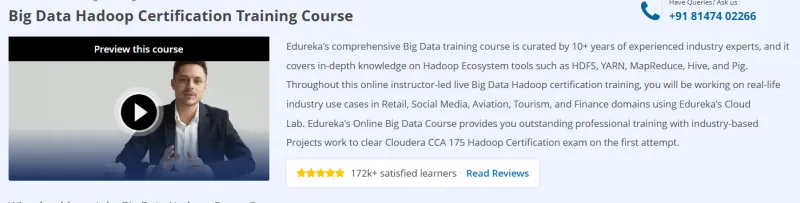
Understand Big Data ecosystems and Hadoop core components: HDFS, YARN, MapReduce, and Hadoop 3.x enhancements
-
Ingest and process large datasets using MapReduce programming and high-level abstractions like Hive and Pig
-
Implement real-time data processing with Apache Spark on YARN, leveraging RDDs, DataFrames, and Spark SQL
-
Manage data workflows and orchestration using Apache Oozie and Apache Sqoop for database imports/exports
Program Overview
Module 1: Introduction to Big Data & Hadoop Ecosystem
⏳ 1 hour
-
Topics: Big Data characteristics (5 V’s), Hadoop history, ecosystem overview (Sqoop, Flume, Oozie)
-
Hands-on: Navigate a pre-configured Hadoop cluster, explore HDFS with basic shell commands
Module 2: HDFS & YARN Fundamentals
⏳ 1.5 hours
-
Topics: HDFS architecture (NameNode/DataNode), replication, block size; YARN ResourceManager and NodeManager
-
Hands-on: Upload/download files, simulate node failure, and write YARN application skeletons
Module 3: MapReduce Programming
⏳ 2 hours
-
Topics: MapReduce job flow,
Mapper/Reducerinterfaces, Writable types, job configuration and counters -
Hands-on: Develop and run a WordCount and Inverted Index MapReduce job end-to-end
Module 4: Hive & Pig for Data Warehousing
⏳ 1.5 hours
-
Topics: Hive metastore, SQL-like queries, partitioning, indexing; Pig Latin scripts and UDFs
-
Hands-on: Create Hive tables over HDFS data and execute analytical queries; write Pig scripts for ETL tasks
Module 5: Real-Time Processing with Spark on YARN
⏳ 2 hours
-
Topics: Spark architecture, RDD vs. DataFrame vs. Dataset APIs; Spark SQL and streaming basics
-
Hands-on: Build and run a Spark application for batch analytics and a simple structured streaming job
Module 6: Data Ingestion & Orchestration
⏳ 1 hour
-
Topics: Sqoop imports/exports between RDBMS and HDFS; Flume sources/sinks; Oozie workflow definitions
-
Hands-on: Automate daily data ingestion from MySQL into HDFS and schedule a multi-step Oozie workflow
Module 7: Cluster Administration & Security
⏳ 1.5 hours
-
Topics: Hadoop configuration files, high availability NameNode, Kerberos authentication, Ranger/Knox basics
-
Hands-on: Configure HA NameNode setup and secure HDFS using Kerberos principals
Module 8: Performance Tuning & Monitoring
⏳ 1 hour
-
Topics: Resource tuning (memory, parallelism), job profiling with YARN UI, cluster monitoring with Ambari
-
Hands-on: Tune Spark executor settings and analyze MapReduce job performance metrics
Module 9: Capstone Project – End-to-End Big Data Pipeline
⏳ 2 hours
-
Topics: Integrate ingestion, storage, processing, and analytics into a cohesive workflow
-
Hands-on: Build a complete pipeline: ingest clickstream data via Sqoop/Flume, process with Spark/Hive, and visualize results
Get certificate
Job Outlook
-
Big Data Engineer: $110,000–$160,000/year — design and maintain large-scale data platforms with Hadoop and Spark
-
Data Architect: $120,000–$170,000/year — architect end-to-end data solutions spanning batch and streaming workloads
-
Hadoop Administrator: $100,000–$140,000/year — deploy, secure, and optimize production Hadoop clusters for enterprise use
Explore More Learning Paths
Take your engineering and data expertise to the next level with these hand-picked programs designed to strengthen your big data skills and advance your analytics career.
Related Courses
-
Big Data Specialization Course – Build a strong foundation in big data concepts, tools, and processing techniques to handle large-scale datasets with confidence.
-
Big Data Integration and Processing Course – Master data ingestion, transformation, and distributed processing pipelines used in real-world enterprise environments.
-
Data Engineering, Big Data, and Machine Learning on GCP Specialization Course – Learn how to design, build, and manage scalable data solutions on Google Cloud using the latest big data and ML technologies.
Related Reading
Gain deeper insight into how data management powers modern analytics:
-
What Is Data Management? – Understand the systems and practices that ensure your organization’s data remains accurate, accessible, and secure.