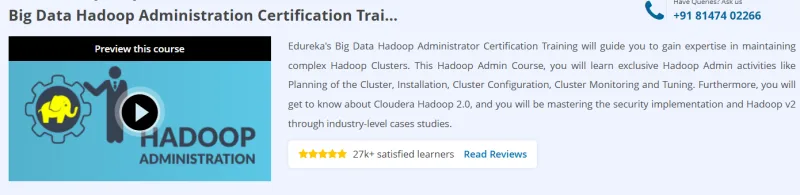
What will you learn in Big Data Hadoop Administration Certification Training Course
-
Install, configure, and manage Hadoop clusters (HDFS, YARN, MapReduce) on Linux
-
Administer Hadoop ecosystem components: Hive, HBase, Oozie, Sqoop, and Flume
-
Monitor cluster health, tune performance, and troubleshoot common issues
-
Secure Hadoop deployments with Kerberos authentication, HDFS ACLs, and Ranger policies
-
Implement high availability (NameNode HA, ResourceManager HA), federation, and disaster recovery
Program Overview
Module 1: Hadoop Architecture & Setup
⏳ 1 week
-
Topics: Hadoop ecosystem overview, node roles, architecture components
-
Hands-on: Install Java and Hadoop prerequisites; configure single-node and pseudo-distributed clusters
Module 2: HDFS Administration
⏳ 1 week
-
Topics: HDFS commands, block replication, storage policies, quotas
-
Hands-on: Create directories and files, simulate DataNode failure, and verify automatic replication
Module 3: YARN & MapReduce Management
⏳ 1 week
-
Topics: YARN ResourceManager/NodeManager, application lifecycles, MapReduce job monitoring
-
Hands-on: Submit and monitor MapReduce jobs; tune memory and container settings
Module 4: Ecosystem Component Administration
⏳ 1 week
-
Topics: Hive metastore setup, HBase schema design, Oozie workflows, Sqoop imports/exports, Flume agents
-
Hands-on: Deploy and configure Hive, create HBase tables, schedule an Oozie workflow, and ingest data with Flume/Sqoop
Module 5: High Availability & Federation
⏳ 1 week
-
Topics: NameNode HA with ZooKeeper, ResourceManager HA, HDFS federation architecture
-
Hands-on: Configure a two-NameNode HA cluster and test failover; set up multiple namespaces with federation
Module 6: Security & Access Control
⏳ 1 week
-
Topics: Kerberos fundamentals, HDFS ACLs, Ranger/Knox integration, SSL encryption
-
Hands-on: Secure the cluster with Kerberos, define HDFS ACLs, and apply Ranger policies for Hive access
Module 7: Cluster Monitoring & Performance Tuning
⏳ 1 week
-
Topics: Metrics collection (Ambari/Grafana), log analysis, JVM tuning, network/file system optimization
-
Hands-on: Set up Ambari dashboards, analyze slow jobs, and apply tuning knobs for HDFS and YARN
Module 8: Backup, Recovery & Disaster Planning
⏳ 1 week
-
Topics: HDFS snapshots, metadata backup, rolling upgrades, cluster rollback
-
Hands-on: Create and restore HDFS snapshots; simulate upgrade and perform rollback
Get certificate
Job Outlook
-
Hadoop administrators are in strong demand for Big Data infrastructure roles in finance, telecom, and e-commerce
-
Roles include Hadoop Administrator, Big Data Engineer, and Data Platform Specialist
-
Salaries range from $95,000 to $140,000+ depending on experience and region
-
Expertise in ecosystem tools (Hive, HBase, Spark) enhances career growth toward architect and SRE positions
Explore More Learning Paths
Take your data engineering expertise to the next level with these hand-picked programs designed to deepen your big data skills and accelerate your career in large-scale system management.
Related Courses
-
Big Data Specialization Course – Gain a complete foundation in big data ecosystems, frameworks, and processing techniques to strengthen your engineering and analytics capabilities.
-
Big Data Integration and Processing Course – Learn how to integrate, process, and manage massive datasets across distributed environments using modern data engineering tools.
-
Data Engineering, Big Data, and Machine Learning on GCP Specialization Course – Master scalable data pipelines, big data architecture, and ML workflows using Google Cloud’s industry-leading environment.
Related Reading
Gain deeper insight into how data engineering drives real-world systems:
-
What Does a Data Engineer Do? – Understand the responsibilities, tools, and daily workflows that shape the data engineering profession.