9.5/10
Highly Recommended
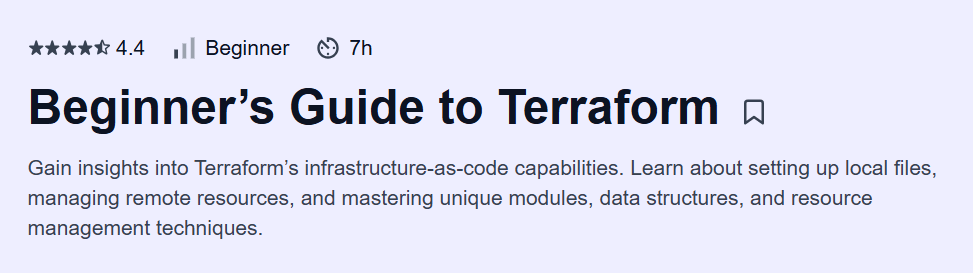
Beginner’s Guide to Terraform Course on Educative — A thorough, hands-on introduction to Terraform that equips infrastructure practitioners with the skills to automate, test, and collaborate on cloud resources.
Pros
- Clear progression from basic configurations to modules and CI/CD integration
- Emphasis on state management and best practices ensures production readiness
- Hands-on labs cover real-world scenarios across multiple cloud providers
Cons
- Focuses on AWS examples; multi-cloud modules are shown but could be deeper
- Testing coverage with Terratest is introductory—advanced testing patterns require further study
Beginner’s Guide to Terraform Course Course
Platform: Educative
Instructor: Developed by MAANG Engineers
What will you learn in Beginner’s Guide to Terraform Course
-
Understand infrastructure as code (IaC) principles and Terraform’s architecture
-
Write and organize Terraform configurations using HCL (HashiCorp Configuration Language)
-
Manage providers, resources, variables, outputs, and state files effectively
-
Implement modules for reusable infrastructure components and follow best practices
-
Plan, apply, and destroy infrastructure safely with Terraform CLI and remote backends
Program Overview
Module 1: Introduction to Terraform & IaC
⏳ 1 week
-
Topics: IaC benefits, Terraform vs. other tools, installation, CLI basics
-
Hands-on: Install Terraform, initialize a directory, and run terraform init
Module 2: Writing Your First Configuration
⏳ 1 week
-
Topics: HCL syntax, declaring providers and resources, basic resource attributes
-
Hands-on: Create an AWS EC2 instance and output its public IP
Module 3: Variables, Outputs & State Management
⏳ 1 week
-
Topics: Input variables (types, defaults), outputs for consumption, local vs. remote state, locking
-
Hands-on: Parameterize your EC2 configuration and store state in an S3 backend
Module 4: Resource Dependencies & Provisioners
⏳ 1 week
-
Topics: Implicit vs. explicit dependencies, depends_on, local and remote provisioners
-
Hands-on: Deploy a web server on EC2 and configure it using a remote-exec provisioner
Module 5: Modules & Code Organization
⏳ 1 week
-
Topics: Creating and using modules, registry modules, versioning, input/output maps
-
Hands-on: Build a VPC module and reuse it across multiple environments
Module 6: Terraform Workspaces & Environment Management
⏳ 1 week
-
Topics: Workspaces for isolation, naming strategies, managing multiple environments
-
Hands-on: Create separate dev and prod workspaces and deploy different configurations
Module 7: Terraform Best Practices & Testing
⏳ 1 week
-
Topics: Code formatting, linting (terraform fmt, validate), security scanning, Terratest basics
-
Hands-on: Validate configurations, run terraform fmt, and write a simple Go test
Module 8: Collaboration & CI/CD Integration
⏳ 1 week
-
Topics: Remote state locking, Terraform Cloud/Enterprise, integrating with GitHub Actions or Jenkins
-
Hands-on: Set up a GitHub Actions pipeline to plan and apply on merge to main
Job Outlook
-
Terraform skills are in high demand for DevOps Engineer, Cloud Engineer, and Infrastructure Engineer roles
-
Widely used by organizations adopting multi-cloud strategies and automated infrastructure
-
Salaries range from $95,000 to $150,000+ depending on region and experience
-
Proficiency with Terraform accelerates career growth in SRE, platform engineering, and site reliability
FAQs
Do I need prior cloud or DevOps experience to learn Terraform?
Basic understanding of cloud concepts (like AWS, Azure, or GCP) is helpful but not mandatory. No prior DevOps or infrastructure-as-code experience is required. The course introduces Terraform fundamentals from scratch. Familiarity with command-line interfaces (CLI) can be useful. Hands-on examples make it easier for beginners to start managing infrastructure.
Can I use Terraform with any cloud provider after this course?
Yes, Terraform supports multiple cloud providers via providers and modules. The course demonstrates core Terraform concepts applicable across clouds. You can manage resources on AWS, Azure, GCP, or other supported platforms. Skills gained allow you to adapt code for different environments easily. Understanding modules and state management is key to multi-cloud deployments.
Will this course cover advanced Terraform features like modules and workspaces?
The course focuses primarily on Terraform fundamentals. Basic module usage and simple configuration management are introduced. Advanced topics like complex module hierarchies, workspaces, and remote state may require additional learning. Core concepts enable learners to extend to advanced features independently. Emphasis is on practical hands-on experience with resources and provisioning.
Is this course suitable for someone transitioning from manual cloud management?
Yes, Terraform helps automate resource provisioning that would otherwise be manual. Learning infrastructure-as-code improves efficiency and reduces human error. Course examples demonstrate provisioning, updating, and destroying resources programmatically. Skills can be applied to automate existing cloud setups. Understanding Terraform syntax and state management is crucial for smooth transitions.
How much hands-on practice will I get in this course?
The course includes step-by-step exercises to create and manage cloud resources. Students practice defining configurations, initializing projects, and applying changes. Hands-on tasks cover resource creation, updates, and deletions safely. Exercises reinforce Terraform syntax, providers, and state file management. Additional practice outside the course is recommended to build confidence and mastery.