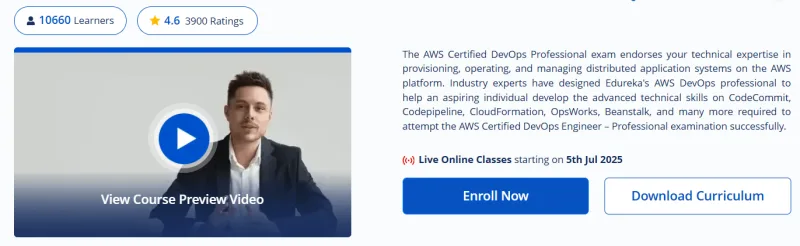
What will you learn in AWS Certified DevOps Engineer – Professional Exam Course
-
Design and implement CI/CD pipelines using AWS Developer Tools (CodeCommit, CodeBuild, CodeDeploy, CodePipeline)
-
Automate infrastructure provisioning with AWS CloudFormation and AWS CDK
-
Containerize applications with Amazon ECS/EKS and deploy serverless workloads with AWS Lambda
-
Implement logging, monitoring, and alerting using Amazon CloudWatch, X-Ray, and AWS Config
-
Secure DevOps practices: IAM roles, KMS encryption, and vulnerability scanning
-
Prepare for the AWS Certified DevOps Engineer – Professional exam
Program Overview
Module 1: DevOps Fundamentals & AWS Overview
⏳ 1 week
-
Topics: DevOps culture, AWS shared responsibility, key services
-
Hands-on: Set up IAM roles and a baseline VPC for DevOps workflows
Module 2: Source Control & CodeCommit
⏳ 1 week
-
Topics: Git basics, CodeCommit repositories, branch strategies
-
Hands-on: Migrate a local Git repo to CodeCommit and configure triggers
Module 3: Build & Test with CodeBuild
⏳ 1 week
-
Topics: Buildspec files, managed vs. custom images, test integration
-
Hands-on: Create a CodeBuild project to compile and unit-test a sample app
Module 4: Deployment Automation
⏳ 1 week
-
Topics: CodeDeploy blue/green and canary deployments, AWS Lambda deployments
-
Hands-on: Deploy to EC2 Auto Scaling groups and a Lambda function via CodeDeploy
Module 5: CI/CD Orchestration with CodePipeline
⏳ 1 week
-
Topics: Pipeline stages, approvals, cross-account pipelines
-
Hands-on: Build an end-to-end pipeline integrating CodeCommit → CodeBuild → CodeDeploy
Module 6: Infrastructure as Code
⏳ 1 week
-
Topics: CloudFormation templates, stacks, change sets, drift detection
-
Hands-on: Write and deploy a multi-tier CloudFormation stack
Module 7: Container & Serverless Deployments
⏳ 1 week
-
Topics: Amazon ECS/EKS, Fargate, ECR, Lambda packaging best practices
-
Hands-on: Containerize a microservice, push to ECR, and deploy on ECS Fargate
Module 8: Monitoring, Logging & Security
⏳ 1 week
-
Topics: CloudWatch metrics/logs/alarms, X-Ray tracing, AWS Config rules, KMS, Secrets Manager
-
Hands-on: Instrument an application for tracing and set up compliance checks
Module 9: Exam Prep & Capstone Project
⏳ 1 week
-
Topics: Exam blueprint review, sample scenario questions, study strategies
-
Hands-on: Design, build, and present a full DevOps solution on AWS
Get certificate
Job Outlook
-
AWS DevOps Engineers are highly sought after to streamline delivery and operations in cloud environments
-
Roles include DevOps Engineer, Site Reliability Engineer, Cloud Automation Engineer
-
Average salaries range from $115,000 to $160,000+ depending on experience and region
-
Skills are applicable across startups, enterprises, and consulting firms adopting AWS
Explore More Learning Paths
Take your engineering and management expertise to the next level with these hand-picked programs designed to expand your skills and boost your leadership potential.
Related Courses
-
IBM Applied DevOps Engineering Professional Certificate Course – Build practical DevOps skills through CI/CD pipelines, containerization, automation, and cloud-native development, backed by IBM experts.
-
IBM DevOps and Software Engineering Professional Certificate Course – Learn end-to-end DevOps practices including version control, SRE, microservices, test automation, and modern software delivery workflows.
-
Preparing for Google Cloud Certification: Cloud DevOps Engineer Professional Certificate Course – Get exam-ready for Google Cloud’s DevOps certification with hands-on labs in monitoring, automation, SRE practices, and platform deployment.
Related Reading
Gain deeper insight into how project management drives real-world success:
-
What Is Project Management? – Understand the principles that make every great project a success story.