What will you learn in Automation Testing using TestComplete 11.0 Course
-
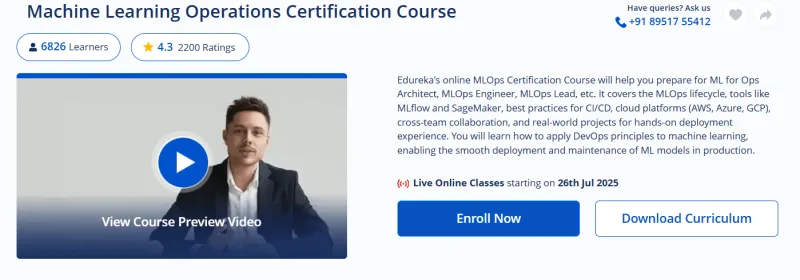
Grasp the end-to-end MLOps lifecycle, from data preparation to model monitoring.
-
Containerize machine learning models using Docker and manage them with Kubernetes.
-
Build automated ML pipelines with tools like Airflow and Jenkins.
-
Implement CI/CD practices tailored for data and model versioning.
-
Monitor model performance in production and handle drift using Prometheus and Grafana.
-
Leverage feature stores and experiment tracking with MLflow or similar platforms.
Program Overview
Module 1: Introduction to MLOps & Architecture
⏳ 2 hours
-
Topics: MLOps principles, differences from DevOps, MLOps components.
-
Hands-on: Sketch an MLOps reference architecture and identify toolchain components.
Module 2: Version Control & Experiment Tracking
⏳ 2.5 hours
-
Topics: Git for code, DVC for data and model versioning, MLflow overview.
-
Hands-on: Track an experiment end-to-end with DVC and MLflow.
Module 3: Containerization with Docker
⏳ 3 hours
-
Topics: Docker images, Dockerfiles, best practices for ML workloads.
-
Hands-on: Containerize a trained model and run inference in a Docker container.
Module 4: Orchestration with Kubernetes
⏳ 3.5 hours
-
Topics: Kubernetes basics, pods, deployments, services, ConfigMaps and Secrets.
-
Hands-on: Deploy your Dockerized model on a local Kubernetes cluster.
Module 5: Building Automated Pipelines
⏳ 3 hours
-
Topics: Airflow DAGs, pipeline scheduling, retries, and monitoring.
-
Hands-on: Create an Airflow pipeline that ingests data, trains a model, and registers it.
Module 6: CI/CD for ML
⏳ 3 hours
-
Topics: Jenkins/GitHub Actions pipelines, automated testing of data and code.
-
Hands-on: Set up a CI/CD workflow that runs unit tests, trains, and deploys a model.
Module 7: Model Serving & APIs
⏳ 2.5 hours
-
Topics: Model serving frameworks (FastAPI, TensorFlow Serving), load balancing.
-
Hands-on: Expose your model as a REST API with Docker and test it with sample requests.
Module 8: Monitoring & Observability
⏳ 2.5 hours
-
Topics: Metrics collection, Prometheus exporters, Grafana dashboards.
-
Hands-on: Instrument your serving endpoint, collect metrics, and visualize them.
Module 9: Feature Store & Data Management
⏳ 2 hours
-
Topics: Concepts of feature stores, online vs. offline features, data cataloging.
-
Hands-on: Set up a simple feature store and retrieve features for inference.
Module 10: Capstone Project – End-to-End MLOps Pipeline
⏳ 4 hours
-
Topics: Combine all components to automate training, deployment, and monitoring.
-
Hands-on: Deliver a fully automated pipeline that retrains on new data and updates production.
Get certificate
Job Outlook
-
MLOps engineers are among the fastest-growing roles in AI, with salaries ranging $110K–$160K+.
-
Expertise in CI/CD, container orchestration, and model monitoring is highly sought by tech companies and enterprises embarking on AI projects.
-
Skills translate into roles such as MLOps Engineer, ML Platform Engineer, and AI Infrastructure Architect.
-
Growing freelance opportunities exist to build robust ML workflows for startups and consultancies.
Explore More Learning Paths
Enhance your automation testing and Python programming skills with these carefully selected courses designed to help you streamline workflows, test applications efficiently, and automate real-world tasks.
Related Courses
-
Google IT Automation with Python Professional Certificate Course – Learn to automate IT tasks, write Python scripts, and streamline administrative processes.
-
Automating Real-World Tasks with Python Course – Gain hands-on experience in automating practical tasks using Python for increased productivity.
-
Automate Cybersecurity Tasks with Python Course – Learn how to apply Python automation in cybersecurity tasks to enhance security operations.
Related Reading
-
What Is Python Used For – Discover Python’s role in automation, testing, and process optimization across industries.