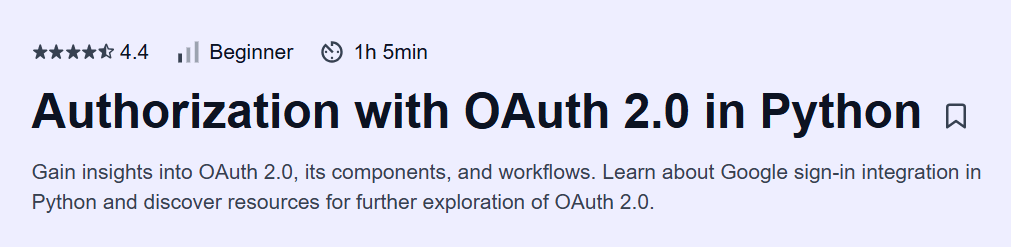
What will you learn in Authorization with OAuth 2.0 in Python Course
-
Understand OAuth 2.0 roles, grant types, and flow diagrams (Authorization Code, Client Credentials, Implicit, Resource Owner Password)
-
Configure an OAuth 2.0 authorization server using Python frameworks (e.g., Flask-Dance, Authlib)
-
Secure Python APIs with token validation, scopes, and claims using JWTs
-
Implement refresh tokens, token revocation, and introspection endpoints
-
Integrate third-party identity providers (Google, Facebook) and apply best practices for secure deployments
Program Overview
Module 1: OAuth 2.0 Fundamentals
⏳ 1 week
-
Topics: OAuth roles (client, resource owner, authorization server, resource server), grant types overview
-
Hands-on: Diagram and simulate each grant type using Postman
Module 2: Setting Up a Python Auth Server
⏳ 1 week
-
Topics: Choosing libraries (Authlib, OAuthLib), issuer configuration, client registration
-
Hands-on: Build a minimal Flask authorization server issuing access and refresh tokens
Module 3: JWT & Token Management
⏳ 1 week
-
Topics: JWT structure (header, payload, signature), signing algorithms, token blacklisting
-
Hands-on: Encode/decode JWTs, implement token revocation and introspection endpoints
Module 4: Securing APIs with Scopes & Claims
⏳ 1 week
-
Topics: Defining and enforcing scopes, custom claims, audience restrictions
-
Hands-on: Protect Flask-RESTful endpoints, enforce scope checks in middleware
Module 5: Refresh Tokens & Token Rotation
⏳ 1 week
-
Topics: Refresh token grant, rotation strategies, one-time use refresh tokens
-
Hands-on: Implement a secure refresh-token endpoint with rotation and reuse detection
Module 6: Integrating Social Logins
⏳ 1 week
-
Topics: OAuth 2.0 as a client, redirect flows, handling provider quirks
-
Hands-on: Add “Log in with Google” to your Python app using Flask-Dance or Authlib
Module 7: Advanced Security & Best Practices
⏳ 1 week
-
Topics: PKCE, CORS configuration, HTTPS enforcement, rate-limiting tokens
-
Hands-on: Harden your auth server with PKCE for public clients and secure cookie storage
Module 8: Capstone Project – Full OAuth Integration
⏳ 1 week
-
Topics: End-to-end design, documentation, testing strategies
-
Hands-on: Develop a sample microservice architecture with an auth server, resource APIs, and a React/Angular front-end using the complete OAuth 2.0 setup
Get certificate
Job Outlook
-
OAuth 2.0 expertise is critical for roles like Backend Engineer, Security Engineer, and API Developer
-
Widely sought in organizations building secure APIs, microservices, and mobile applications
-
Salaries range from $95,000 to $155,000+ depending on region and experience
-
Mastery of OAuth flows and JWT management boosts employability in enterprise and cloud-native environments
Explore More Learning Paths
Enhance your Python programming and security skills with these curated courses, designed to help you automate tasks, integrate APIs, and build secure applications.
Related Courses
-
Automating Real-World Tasks with Python Course – Learn to use Python for automation, including interacting with APIs and managing data efficiently.
-
Automate Cybersecurity Tasks with Python Course – Apply Python programming to automate security processes, analyze vulnerabilities, and manage authorization protocols.
-
Applied Machine Learning in Python Course – Explore machine learning applications in Python while understanding secure data handling and API integration.
Related Reading
-
What Is Python Used For? – Discover the wide range of Python applications, from automation and security to data science and API development.