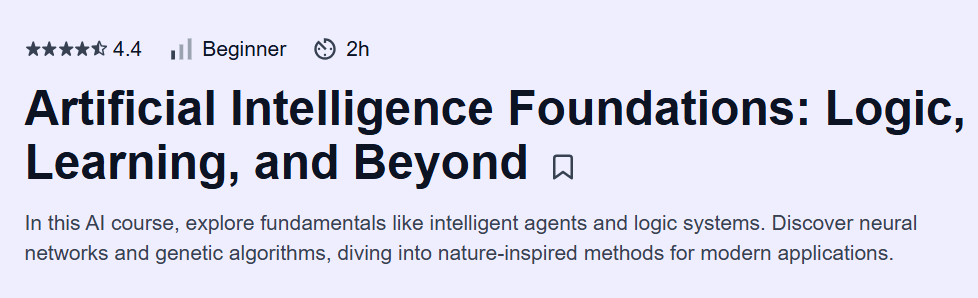
What will you learn in Artificial Intelligence Foundations: Logic, Learning, and Beyond Course
-
Grasp core AI concepts: search, knowledge representation, planning, and learning
-
Understand machine learning paradigms: supervised, unsupervised, and reinforcement learning
-
Explore neural networks fundamentals: perceptrons, backpropagation, and deep learning basics
-
Apply AI techniques to practical problems: classification, clustering, and sequential decision-making
-
Evaluate AI models using metrics and cross-validation, and understand ethical considerations
Program Overview
Module 1: Foundations of AI
⏳ 1 week
-
Topics: History of AI, Turing Test, rational agents, PEAS frameworks
-
Hands-on: Define a PEAS description and implement a simple reflex agent in Python
Module 2: Problem Solving & Search
⏳ 1 week
-
Topics: Uninformed search (BFS, DFS), informed search (A*, heuristics)
-
Hands-on: Build and compare BFS vs. A* on path-finding grids
Module 3: Knowledge Representation & Logic
⏳ 1 week
-
Topics: Propositional and first-order logic, inference, resolution
-
Hands-on: Encode simple puzzles in propositional logic and solve via resolution
Module 4: Planning & Decision Making
⏳ 1 week
-
Topics: STRIPS representation, forward/backward planning, Markov Decision Processes
-
Hands-on: Implement value iteration on a grid-world MDP
Module 5: Machine Learning Basics
⏳ 1 week
-
Topics: Linear regression, logistic regression, decision trees, overfitting
-
Hands-on: Train and evaluate models on a public dataset using scikit-learn
Module 6: Unsupervised Learning & Clustering
⏳ 1 week
-
Topics: K-means, hierarchical clustering, dimensionality reduction (PCA)
-
Hands-on: Cluster customer data and visualize results with PCA projections
Module 7: Neural Networks & Deep Learning Intro
⏳ 1 week
-
Topics: Perceptron, multilayer networks, activation functions, backpropagation
-
Hands-on: Build a two-layer neural network from scratch to classify MNIST digits
Module 8: Reinforcement Learning Basics
⏳ 1 week
-
Topics: Exploration vs. exploitation, Q-learning, policy gradients overview
-
Hands-on: Implement Q-learning for a simple OpenAI Gym environment
Get certificate
Job Outlook
-
AI Fundamentals are critical for roles like AI Engineer, Data Scientist, and Research Associate
-
Foundational knowledge opens doors in tech, healthcare, finance, and robotics industries
-
Salaries for entry-level AI positions typically start around $85,000, rising to $150,000+ with experience
-
Strong base for advanced AI specializations in NLP, computer vision, and reinforcement learning
Explore More Learning Paths
Deepen your understanding of AI’s core principles — from logic and reasoning to learning algorithms — with these curated learning paths that complement and enhance your foundational AI knowledge.
Related Courses
-
Introduction to AI Course
Start with essential AI concepts and explore how intelligent systems operate in the real world. -
IBM AI Developer Professional Certificate Course
A hands-on program building your skills in machine learning models, neural networks, and production-grade AI tools. -
Introduction to Artificial Intelligence (AI) Course
Learn core AI methodologies and problem-solving techniques used across industries.
Related Reading
-
What Is Python Used For
Python is the backbone of AI and machine learning. This article explains why it’s the go-to language for logic programming, data processing, and building intelligent systems.