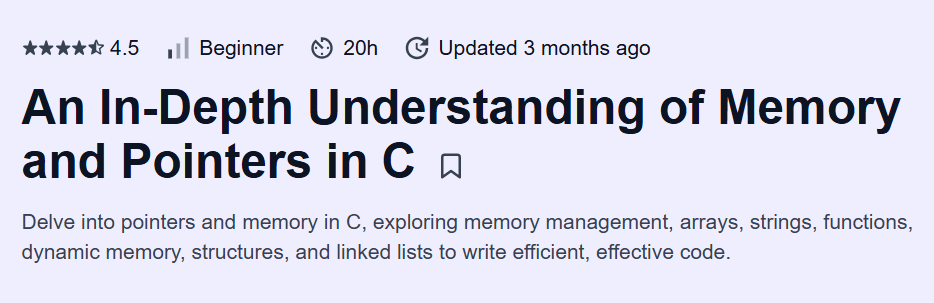
What will you learn in An In-Depth Understanding of Memory and Pointers in C Course
-
Master C’s memory model: stack vs. heap vs. static segments and variable lifetimes
-
Confidently declare and use pointers, including dereferencing, pointer arithmetic, and safety checks
-
Allocate and manage dynamic memory with
malloc,calloc,realloc, and properfreeusage
-
Leverage advanced pointer constructs: function pointers, pointer-to-pointer, and custom allocators
-
Debug and prevent common memory issues: dangling pointers, leaks, buffer overflows, and alignment pitfalls
Program Overview
Module 1: C Memory Model Essentials
⏳ 1 week
-
Topics: Variable storage durations (automatic, static), memory regions, stack frames
-
Hands-on: Use
objdumpand simple C programs to map variables to stack and data segments
Module 2: Pointer Fundamentals
⏳ 1 week
-
Topics: Pointer syntax, indirection (
*), address-of (&), NULL and void pointers -
Hands-on: Write swap and array-traversal functions using pointers
Module 3: Pointer Arithmetic & Arrays
⏳ 1 week
-
Topics: Incrementing/decrementing pointers, pointer–array equivalence, multi-dimensional arrays
-
Hands-on: Implement matrix operations (addition, multiplication) via pointer arithmetic
Module 4: Dynamic Memory Management
⏳ 1 week
-
Topics:
mallocvs.calloc, resizing withrealloc, detecting and avoiding leaks -
Hands-on: Build a dynamic vector that grows as elements are appended
Module 5: Function Pointers & Callbacks
⏳ 1 week
-
Topics: Declaring/calling function pointers, callback patterns, and dispatch tables
-
Hands-on: Create a generic sort routine accepting different comparison callbacks
Module 6: Pointers-to-Pointers & Data Structures
⏳ 1 week
-
Topics: Double pointers, dynamic 2D arrays, linked lists, trees via pointers
-
Hands-on: Implement a singly linked list with insert, delete, and traversal functions
Module 7: Memory Safety & Debugging
⏳ 1 week
-
Topics: Common pitfalls (use-after-free, buffer overruns), tools (
valgrind, AddressSanitizer) -
Hands-on: Introduce intentional memory bugs and diagnose/fix them using
valgrind
Module 8: Best Practices & Capstone Project
⏳ 1 week
-
Topics: Alignment, custom memory pools, RAII-like patterns via macros, documentation
-
Hands-on: Design and integrate a simple memory-pool allocator into a sample application
Get certificate
Job Outlook
-
Deep C memory expertise is critical for systems, embedded, and performance-sensitive development
-
Roles include Embedded Software Engineer, Systems Programmer, Firmware Developer, and Kernel Module Engineer
-
Salaries range from $85,000 to $150,000+ based on specialization and experience
-
Mastery of pointers and memory management reduces critical bugs and enhances security in low-level codebases
Explore More Learning Paths
Deepen your understanding of C programming, memory management, and pointers with these related courses and resources. These learning paths will help you strengthen your coding fundamentals and build professional programming skills.
Related Courses
-
Go and C Programming in Two Successor Languages of C Specialization
Explore C and its successor languages, Go and C++, to enhance your programming versatility and understanding of modern software development. -
Learn C from Scratch
Build a solid foundation in C programming, covering syntax, functions, memory management, and basic data structures. -
C Fundamentals for Professionals
Strengthen your professional C programming skills, focusing on memory handling, pointers, and efficient coding practices.
Related Reading
-
What Is Python Used For
Understand how programming concepts like memory management and pointers in C relate to Python and other modern languages in software development.