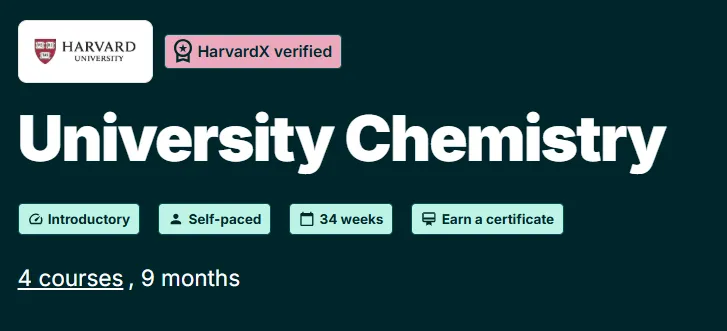
What will you learn in University Chemistry course
- This MicroBachelors® program provides a rigorous, university-level foundation in general chemistry.
- Learners will understand atomic structure, chemical bonding, and periodic trends.
- The program emphasizes quantitative problem-solving, stoichiometry, and thermodynamics.
- Students will explore reaction kinetics, equilibrium, acids and bases, and electrochemistry.
- Mathematical reasoning and scientific analysis are integrated throughout the coursework.
- By completing the program, participants gain transferable college credit and strong preparation for STEM degree pathways.
Program Overview
Atomic Structure and Periodic Properties
⏳ 6–8 Weeks
- Understand atomic models and electron configurations.
- Study periodic table trends.
- Explore quantum principles in chemistry.
- Develop foundational problem-solving skills.
Chemical Bonding and Molecular Structure
⏳ 6–8 Weeks
- Learn ionic and covalent bonding concepts.
- Understand Lewis structures and VSEPR theory.
- Explore molecular geometry and polarity.
- Analyze intermolecular forces.
Thermodynamics and Chemical Reactions
⏳ 6–8 Weeks
- Study energy changes in chemical reactions.
- Understand enthalpy, entropy, and Gibbs free energy.
- Explore calorimetry and reaction energetics.
- Apply thermodynamic calculations.
Kinetics, Equilibrium, and Electrochemistry
⏳ 6–8 Weeks
- Understand reaction rates and rate laws.
- Study chemical equilibrium and Le Chatelier’s principle.
- Explore acid-base chemistry.
- Learn redox reactions and electrochemical cells.
Get certificate
Job Outlook
- Foundational chemistry knowledge is essential for careers in medicine, pharmacy, biotechnology, environmental science, chemical engineering, and materials science.
- Students pursuing STEM degrees benefit significantly from strong general chemistry preparation.
- Chemistry-related careers such as Laboratory Technician, Chemical Engineer, Research Scientist, and Pharmacist often offer salaries ranging from $60K–$130K+, depending on specialization and education level.
- This MicroBachelors® program provides transferable academic credit that may reduce time and cost toward completing a bachelor’s degree.
- It also strengthens preparation for advanced coursework in biochemistry, organic chemistry, and materials science.