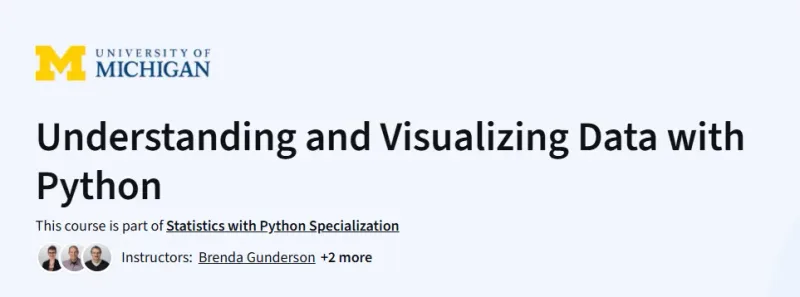
What will you learn in Understanding and Visualizing Data with Python Course
-
Identify and understand different types of data (categorical, quantitative) and how they are collected.
-
Create data visualizations (histograms, bar charts, box plots, scatter plots) using Python.
-
Analyze multivariate relationships and apply numerical summaries for insight.
-
Explore sampling methods (probability vs non-probability) and learn how sample statistics infer population trends.
Program Overview
Module 1: Introduction to Data & Statistical Thinking
⏳ 1 week
• Topics: Data types, study design, introduction to Jupyter notebook environment
• Hands‑on: Work in labs on variable identification, Python basics, and notebook navigation
Module 2: Univariate Visualizations & Summaries
⏳ 1 week
• Topics: Bar charts, histograms, box plots, and basic numerical summaries like mean, median, IQR, standard score
• Hands‑on: Analyze and visualize univariate datasets using Python libraries such as Pandas and Matplotlib
Module 3: Multivariate Relationships & Association
⏳ 1 week
• Topics: Exploring relationships between quantitative and categorical variables, scatter plots, and correlation structures
• Hands‑on: Build multivariate visualizations and interpret patterns in real-world datasets
Module 4: Sampling, Inference & Interpretation
⏳ 1 week
• Topics: Probability vs non-probability sampling, sampling variability, interpreting statistical claims
• Hands‑on: Evaluate sample design examples and apply reasoning on how to generalize findings
Get certificate
Job Outlook
-
Core statistics skills and Python visualization are widely required in roles like Data Analyst, Research Associate, or BI Analyst.
-
Proficiency in tools like Pandas, Matplotlib, and Seaborn is valued in industries such as healthcare, finance, marketing, and academia.
-
Typical salary ranges: ₹6–12 LPA (India), $65K–$100K+ (global) for entry-level roles.
-
Builds a strong foundation for ML, data science, and decision-support roles.
Explore More Learning Paths
Boost your data analytics and visualization skills with these curated courses designed to help you turn raw data into actionable insights and compelling visual stories.
Related Courses
-
Data Visualization and Dashboards with Excel and Cognos Course – Learn to create interactive dashboards and visual reports using Excel and IBM Cognos for better business decision-making.
-
Data Visualization with Tableau Specialization Course – Master Tableau to design insightful, professional-level data visualizations and interactive dashboards.
-
Capstone: Retrieving, Processing, and Visualizing Data with Python Course – Apply your Python skills in a hands-on project, transforming and visualizing real-world datasets.
Related Reading
-
What Is Python Used For? – Discover how Python supports data analysis, visualization, machine learning, and a wide range of real-world applications.