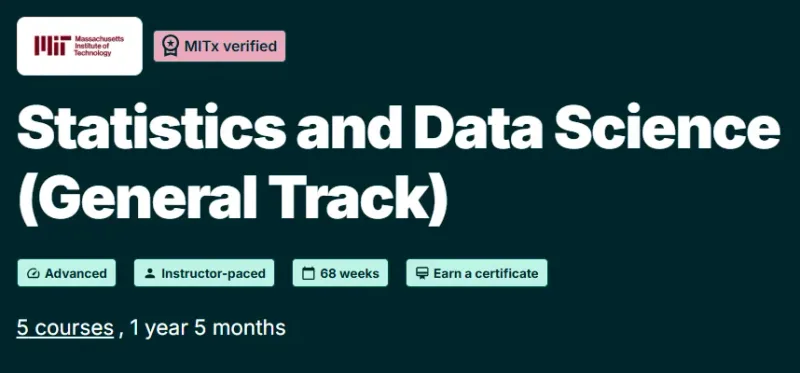
What will you learn in Statistics and Data Science (General Track) course
- This MicroMasters® program delivers graduate-level training in statistics, probability, machine learning, and data analysis.
- Learners will build a strong mathematical foundation in probability theory, statistical inference, and regression modeling.
- The program emphasizes computational tools such as Python for data analysis, machine learning algorithms, and large-scale data processing.
- Students will explore supervised and unsupervised learning techniques, including classification, clustering, and dimensionality reduction.
- Advanced modules introduce data modeling, optimization, and real-world problem-solving using statistical reasoning.
Program Overview
Probability and Statistics Foundations
⏳ 8–10 Weeks
- Understand random variables and probability distributions.
- Learn expectation, variance, and sampling theory.
- Study hypothesis testing and confidence intervals.
- Build strong statistical reasoning skills.
Data Analysis and Regression
⏳ 8–10 Weeks
- Explore linear and logistic regression models.
- Understand model assumptions and diagnostics.
- Apply regression techniques to real-world datasets.
- Interpret results for decision-making.
Machine Learning
⏳ 8–10 Weeks
- Learn supervised learning techniques such as classification and regression.
- Study unsupervised learning including clustering and dimensionality reduction.
- Understand model evaluation, bias-variance trade-offs, and overfitting.
- Apply machine learning methods using Python.
Advanced Data Science & Capstone Exam
⏳ 8–10 Weeks + Final Assessment
- Explore large-scale data analysis and computational modeling.
- Apply end-to-end data science workflows.
- Complete a comprehensive proctored exam to validate mastery.
- Earn the MITx MicroMasters® credential upon successful completion.
Get certificate
Job Outlook
- Statistics and data science professionals are in high demand across industries including technology, healthcare, finance, consulting, manufacturing, and research.
- Roles such as Data Scientist, Machine Learning Engineer, Quantitative Analyst, and AI Researcher require strong statistical and computational skills.
- Entry-level data professionals typically earn between $80K–$100K per year, while experienced data scientists and ML engineers can earn $120K–$170K+ depending on industry and specialization.
- The MicroMasters® credential strengthens applications for advanced graduate programs and leadership roles in data-driven organizations.
- Strong foundations in statistics and machine learning are critical for AI, predictive analytics, automation, and advanced research careers.