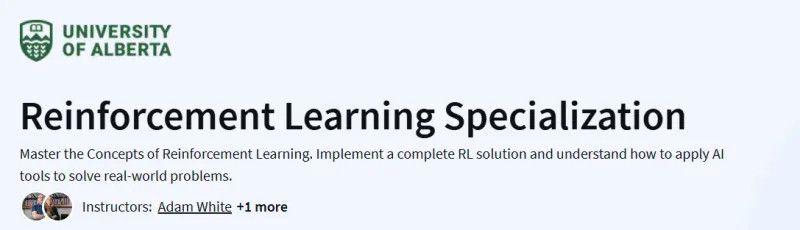
Reinforcement Learning Specialization Course

Reinforcement Learning Specialization Course Course

The "Reinforcement Learning Specialization" offers comprehensive training for individuals aiming to master RL concepts and applications. It's particularly beneficial for professionals seeking to deepe...

Explore This Course Quick Enroll Page
9.7/10 Highly Recommended

Reinforcement Learning Specialization Course on Coursera — The "Reinforcement Learning Specialization" offers comprehensive training for individuals aiming to master RL concepts and applications. It's particularly beneficial for professionals seeking to deepen their understanding of adaptive learning systems and AI.

Pros

  • Developed and taught by experts from the University of Alberta.
  • Includes hands-on projects using real-world scenarios for practical experience.
  • Flexible schedule allowing learners to progress at their own pace.

Cons

  • Requires a commitment of approximately 10 hours per week.
  • Intermediate-level course; prior knowledge of Python programming and machine learning fundamentals is recommended.

Reinforcement Learning Specialization Course Course

Platform: Coursera

Instructor: University of Alberta

What will you learn in this Reinforcement Learning Specialization Course

  • Understand the fundamentals of reinforcement learning (RL) and how it applies to real-world problems.

  • Learn key RL algorithms, including Temporal-Difference learning, Monte Carlo methods, Sarsa, Q-learning, Policy Gradients, and Dyna.

​​​​​​​​​​

  • Develop the ability to formalize tasks as RL problems and implement solutions using Python.

  • Gain insights into how RL complements other machine learning paradigms like supervised and unsupervised learning.

Program Overview

Fundamentals of Reinforcement Learning
⏳  4 weeks

  • Introduction to RL concepts, including Markov Decision Processes (MDPs), value functions, and dynamic programming.

Sample-based Learning Methods
⏳  4 weeks

  • Exploration of learning methods like Monte Carlo and Temporal-Difference learning without explicit environment models.

Prediction and Control with Function Approximation
⏳  4 weeks

  • Application of function approximation techniques, such as neural networks, to handle large state and action spaces.

A Complete Reinforcement Learning System (Capstone)
⏳  4 weeks

  • Integration of concepts learned to build a complete RL solution for a real-world problem.

Get certificate

Job Outlook

  • Equips learners with practical skills applicable to roles such as Machine Learning Engineer, AI Specialist, and Data Scientist.

  • Provides a strong foundation for advanced studies or careers involving autonomous systems, robotics, and intelligent decision-making.

  • Enhances qualifications for positions requiring expertise in adaptive learning systems and AI.

Explore More Learning Paths

Advance your machine learning expertise with these carefully selected programs that strengthen your understanding of reinforcement learning, unsupervised methods, and core AI foundations.

Related Courses

Related Reading

Deepen your understanding of how structured project methodologies support complex AI development:

  • What Is Project Management? – Learn how effective planning and execution frameworks help ensure machine learning projects succeed from experimentation to deployment.
FAQs

How much weekly time should I dedicate to keep pace?
Around 8–10 hours per week is typical. Labs and coding exercises may require extra time. Most learners complete in 3–4 months at steady pace. Flexible scheduling allows pausing and resuming. Consistency in small chunks works better than cramming.
How does this specialization prepare me for research careers?
Covers algorithms used in state-of-the-art RL research. Builds a foundation for reading and understanding RL papers. Capstone project simulates research-style experimentation. Provides coding practice for prototyping new ideas. A good stepping stone to graduate-level AI programs.
Can this course help me transition into robotics or AI-driven systems?
Yes, RL is a key technique in autonomous robotics. Useful in navigation, path optimization, and control systems. Provides foundations for intelligent decision-making agents. Skills also apply to recommendation systems and finance. Positions you for roles in applied AI engineering.
How is reinforcement learning different from standard machine learning?
RL learns from interactions instead of labeled datasets. Focuses on decision-making over time with rewards/penalties. More suited to robotics, games, and adaptive systems. Involves sequential feedback rather than one-shot predictions. Complements supervised and unsupervised learning approaches.
Do I need a strong math background to succeed in this specialization?
A working knowledge of linear algebra and probability is helpful. You don’t need advanced calculus or research-level math. The focus is on application, with math explained in context. Coding ability often matters more than deep theoretical math. Self-study resources can cover any gaps in prerequisites.

Similar Courses

Other courses in Data Science Courses