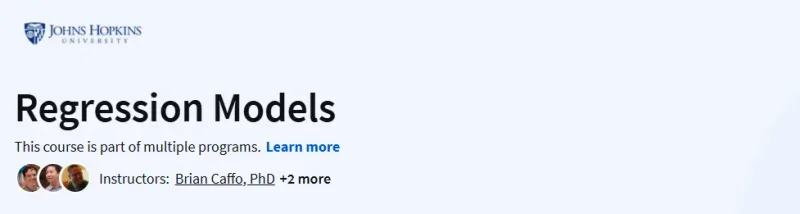
What will you in the Regression Models Course
-
Understand the theory and application of regression analysis, including linear models and their assumptions.
-
Implement and interpret multiple regression, ANOVA, and ANCOVA models.
-
Use residual plots and diagnostics to assess model performance and assumptions.
-
Apply variable selection methods and explore smoothing techniques like loess.
-
Develop proficiency in R programming for regression modeling.
Program Overview
Module 1: Linear Regression Fundamentals
Duration: ~10 hours
-
Introduction to least squares estimation and simple linear regression.
-
Explore concepts like bias, variance, and regression to the mean.
-
Learn how to fit, interpret, and visualize linear models in R.
Module 2: Multivariable Regression
Duration: ~10 hours
-
Apply regression to models with multiple predictors.
-
Analyze confounding, interactions, and multicollinearity.
-
Perform model diagnostics and check residual assumptions.
Module 3: ANOVA and ANCOVA Models
Duration: ~10 hours
-
Use ANOVA to compare multiple group means.
-
Extend to ANCOVA to include covariates in group comparisons.
-
Understand model contrasts and categorical variable handling.
Module 4: Advanced Regression Techniques
Duration: ~10 hours
-
Learn model selection techniques such as AIC, BIC, and stepwise regression.
-
Introduction to polynomial regression and smoothing.
-
Use loess for flexible, non-parametric curve fitting.
Final Project
-
Apply all learned techniques to a data-based modeling assignment.
-
Write and submit a report using R Markdown or knitr.
-
Peer-reviewed by fellow learners.
Get certificate
Job Outlook
-
Data Analysts: Gain essential statistical tools for real-world data modeling.
-
Researchers & Scientists: Enhance analytical rigor in academic or lab-based studies.
-
Economists & Social Scientists: Apply quantitative methods to behavioral and survey data.
-
Business & Marketing Analysts: Use regression to forecast sales, trends, and consumer behavior.
-
Statisticians: Deepen understanding of applied linear modeling strategies.