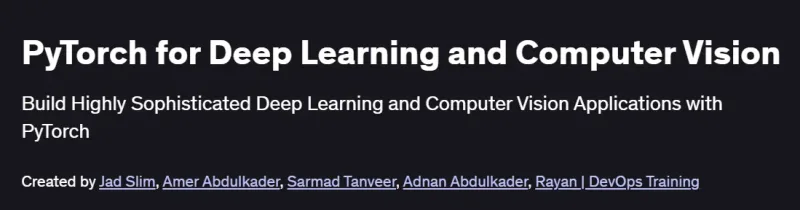
What will you in PyTorch for Deep Learning and Computer Vision Course
-
Master deep learning concepts and neural network design with PyTorch.
-
Build, train, and optimize CNNs for computer vision tasks.
-
Implement key architectures like LeNet, AlexNet, and ResNet.
-
Work with image datasets such as MNIST, CIFAR-10, and custom data.
-
Apply transfer learning, data augmentation, and deployment strategies.
Program Overview
Module 1: Introduction to PyTorch & Deep Learning
⏳ 30 minutes
-
Overview of PyTorch ecosystem and installation.
-
Basics of tensors, gradients, and autograd.
Module 2: Building Neural Networks
⏳ 60 minutes
-
Creating models using
nn.ModuleandSequential. -
Defining loss functions and optimizers.
Module 3: Training Deep Neural Networks
⏳ 60 minutes
-
Building training loops with dataloaders and evaluation cycles.
-
Saving, loading, and reusing trained models.
Module 4: Computer Vision with CNNs
⏳ 75 minutes
-
Building CNNs from scratch for image classification.
-
Applying convolution, pooling, and flattening techniques.
Module 5: Famous Architectures in PyTorch
⏳ 90 minutes
-
Recreating LeNet, AlexNet, VGG, and ResNet models.
-
Adapting pretrained models to new tasks.
Module 6: Working with Image Datasets
⏳ 60 minutes
-
Loading datasets like MNIST and CIFAR-10 with
torchvision. -
Custom dataset handling and preprocessing.
Module 7: Transfer Learning & Fine-Tuning
⏳ 60 minutes
-
Using pretrained models to accelerate training.
-
Modifying output layers and retraining for custom classes.
Module 8: Data Augmentation & Regularization
⏳ 45 minutes
-
Applying
torchvision.transformsfor image enhancement. -
Techniques to improve generalization and reduce overfitting.
Module 9: Final Project – Image Classifier Deployment
⏳ 75 minutes
-
End-to-end pipeline from model creation to inference.
-
Exporting and deploying models in real-world environments.
Get certificate
Job Outlook
-
High Demand: PyTorch skills are sought after in AI, computer vision, and deep learning roles.
-
Career Advancement: Qualifies learners for roles like AI Researcher, Deep Learning Engineer, or Vision Specialist.
-
Salary Potential: Professionals can expect $100K–$170K based on experience and specialization.
-
Freelance Opportunities: Opportunities in building CV solutions for startups, healthcare, and autonomous tech firms.
Explore More Learning Paths
Enhance your deep learning and computer vision skills with PyTorch through these carefully selected programs designed to help you build, train, and deploy advanced neural networks.
Related Courses
-
IBM Deep Learning with PyTorch, Keras, and TensorFlow Professional Certificate Course – Gain hands-on experience with PyTorch and TensorFlow to implement deep learning models for computer vision and other applications.
-
Introduction to Neural Networks and PyTorch Course – Learn the fundamentals of neural networks and PyTorch to develop foundational deep learning skills.
-
PyTorch for Deep Learning Bootcamp Course – Master PyTorch with practical projects, focusing on building, training, and deploying deep learning models.
Related Reading
-
What Does a Data Engineer Do? – Understand how structured data and engineering practices support the development and deployment of deep learning models.