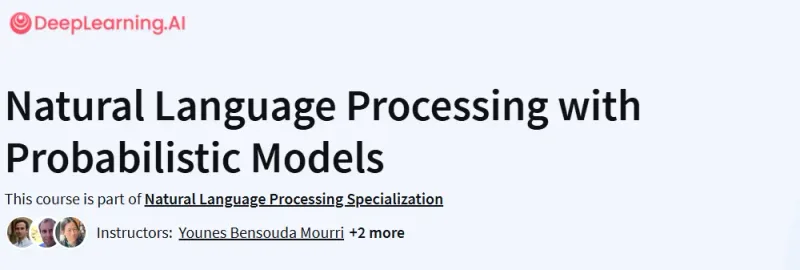
What will you learn in this Natural Language Processing with Probabilistic Models Course
-
Implement autocorrect algorithms using minimum edit distance and dynamic programming.
-
Apply Hidden Markov Models and the Viterbi algorithm for part-of-speech tagging.
-
Develop N-gram language models for autocomplete functionalities.
-
Build Word2Vec models to generate word embeddings using neural networks.
Program Overview
1. Autocorrect
⏳ 6 hours
Learn about autocorrect mechanisms, focusing on minimum edit distance and dynamic programming to correct misspelled words.
2. Part of Speech Tagging and Hidden Markov Models
⏳ 5 hours
Understand Markov chains and Hidden Markov Models, and apply the Viterbi algorithm for tagging parts of speech in text corpora
3. Autocomplete and Language Models
⏳ 8 hours
Explore N-gram language models to calculate sequence probabilities and build autocomplete systems using textual data.
4. Word Embeddings with Neural Networks
⏳ 9 hours
Delve into word embeddings, learning to create Continuous Bag-of-Words (CBOW) models to capture semantic meanings of words.
Get certificate
Job Outlook
-
Implement autocorrect algorithms using minimum edit distance and dynamic programming.
-
Apply Hidden Markov Models and the Viterbi algorithm for part-of-speech tagging.
-
Develop N-gram language models for autocomplete functionalities.
-
Build Word2Vec models to generate word embeddings using neural networks.
Explore More Learning Paths
Take your data science and NLP expertise to the next level with these hand-picked programs designed to deepen your understanding of natural language processing and advanced AI techniques.
Related Courses
-
Natural Language Processing in TensorFlow Course – Learn how to implement NLP models using TensorFlow for practical, real-world applications.
-
Natural Language Processing with Attention Models Course – Master attention mechanisms to enhance NLP model performance and contextual understanding.
-
Natural Language Processing with Sequence Models Course – Explore sequence modeling techniques, including RNNs and LSTMs, to handle complex textual data.
Related Reading
-
What Is Python Used For? – Gain insight into how Python powers NLP and AI applications across industries.