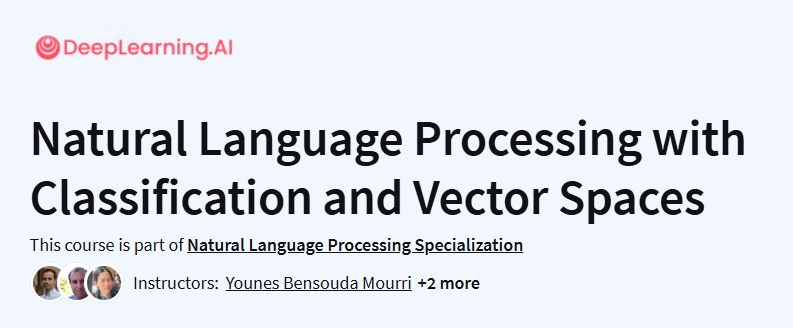
What will you learn in this Natural Language Processing with Classification and Vector Spaces Course
-
Sentiment Analysis: Implement logistic regression and naïve Bayes classifiers to analyze the sentiment of textual data, such as tweets
-
Vector Space Models: Understand and apply vector space models to capture semantic relationships between words, utilizing techniques like Principal Component Analysis (PCA) for dimensionality reduction and visualization
-
Machine Translation: Develop a simple English-to-French translation algorithm using pre-computed word embeddings and locality-sensitive hashing for approximate nearest neighbor search.
Program Overview
1. Sentiment Analysis with Logistic Regression
⏳ 9 hours
-
Extract features from text into numerical vectors.
-
Build a binary classifier for tweets using logistic regression.
-
Understand preprocessing steps and feature extraction techniques.
2. Sentiment Analysis with Naïve Bayes
⏳ 8 hours
-
Learn the theory behind Bayes’ rule and conditional probabilities.
-
Apply these concepts to build a Naïve Bayes tweet classifier.
-
Compare performance with logistic regression models.
3. Vector Space Models
⏳ 8 hours
-
Create word vectors that capture dependencies between words.
-
Use PCA to reduce dimensionality and visualize word relationships.
-
Explore semantic meaning and relationships in vector spaces.
4. Machine Translation and Document Search
⏳ 8 hours
-
Transform word vectors and assign them to subsets using locality-sensitive hashing.
-
Implement a simple English-to-French translation algorithm.
-
Apply techniques to perform document search based on semantic similarity.
Get certificate
Job Outlook
-
Proficiency in NLP techniques is increasingly sought after in roles such as Data Scientist, NLP Engineer, and Machine Learning Engineer.
-
Understanding foundational NLP concepts is essential for developing applications like chatbots, sentiment analysis tools, and translation services.
-
Completing this course can enhance your qualifications and visibility to potential employers in the AI and data science fields.
Explore More Learning Paths
Advance your NLP expertise with these carefully curated programs designed to deepen your understanding of language models, vector representations, and AI-driven text analysis.
Related Courses
-
Natural Language Processing with Sequence Models Course – Learn to build and train sequence-based NLP models for tasks like text generation, translation, and sentiment analysis.
-
Natural Language Processing with Attention Models Course – Explore attention mechanisms and transformer architectures to enhance the performance of NLP models.
-
Natural Language Processing in TensorFlow Course – Gain hands-on experience implementing NLP pipelines using TensorFlow for real-world AI applications.
Related Reading
-
What Is Python Used For? – Understand how Python serves as the backbone for NLP development, including text processing, machine learning, and model deployment.