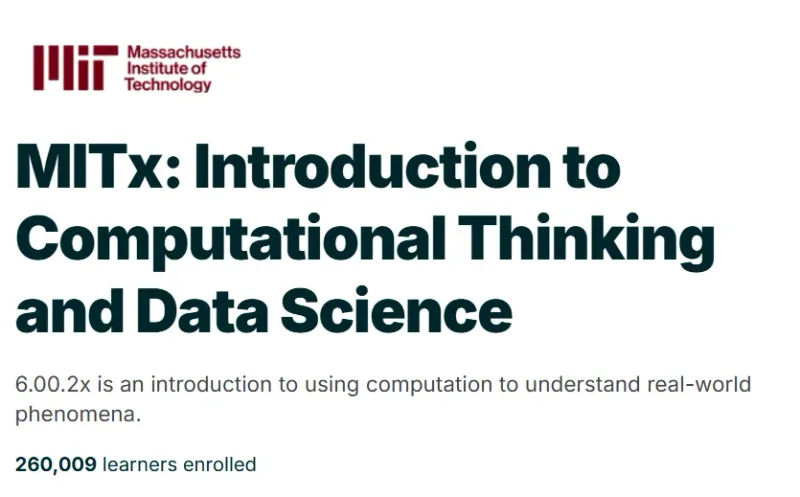
What will you learn in MITx: Introduction to Computational Thinking and Data Science course
- This course provides a rigorous introduction to computational thinking and data science using Python programming.
- Learners will understand how to model real-world problems computationally and simulate complex systems using algorithms.
- The course emphasizes probability, statistical reasoning, and data analysis through hands-on coding exercises.
- Students will explore topics such as random walks, Monte Carlo simulations, optimization problems, and data visualization.
- Real-world examples demonstrate how computational models are used in finance, biology, social sciences, and engineering.
- By the end of the course, participants will develop strong problem-solving skills and practical experience in data-driven computational modeling.
Program Overview
Foundations of Computational Thinking
⏳ 3–4 Weeks
- In this section, you will explore how computers are used to solve complex real-world problems.
- Learn core Python programming concepts.
- Understand abstraction, decomposition, and algorithmic thinking.
- Build simple computational models.
Simulation and Random Processes
⏳ 4–6 Weeks
- This section focuses on modeling uncertainty and randomness.
- Learn Monte Carlo simulation techniques.
- Understand random walks and probabilistic models.
- Apply simulation methods to analyze risk and outcomes.
Data Analysis and Visualization
⏳ 4–6 Weeks
- Here, you will work with datasets using Python.
- Perform statistical analysis and interpret results.
- Visualize data trends using programming tools.
- Develop computational solutions for real-world datasets.
Optimization and Decision Modeling
⏳ 3–4 Weeks
- The final section explores solving optimization problems computationally.
- Learn basic optimization algorithms.
- Analyze trade-offs and constraints in system design.
- Apply computational models to decision-making scenarios.
Get certificate
Job Outlook
- Computational thinking and data science skills are highly valued in technology, finance, research, healthcare, and engineering industries.
- Professionals with Python and data modeling expertise are in demand for roles such as Data Analyst, Data Scientist, Machine Learning Engineer, and Quantitative Analyst.
- Entry-level data analysts typically earn between $70K–$95K per year, while experienced data scientists and machine learning engineers can earn $110K–$160K+ depending on specialization and industry.
- Computational modeling skills are critical for AI development, predictive analytics, risk modeling, and scientific research.
- This course provides a strong foundation for advanced studies in machine learning, artificial intelligence, and data science.