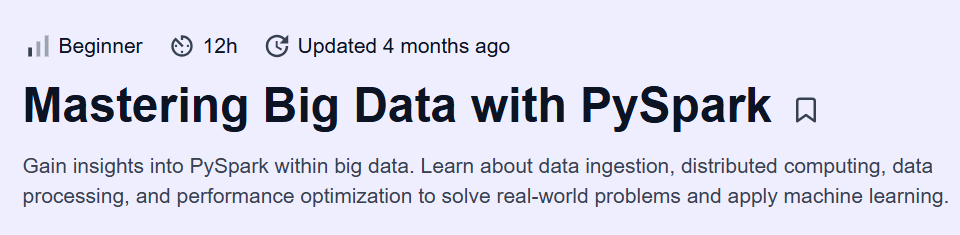
What will you learn in Mastering Big Data with PySpark Course
-
Understand the big data ecosystem: ingestion methods, storage options, and distributed computing fundamentals
-
Leverage PySpark’s core RDD and DataFrame APIs for data processing, transformation, and analysis
-
Build and evaluate machine learning pipelines with PySpark MLlib, including classification, regression, and clustering
-
Optimize Spark performance via partition strategies, broadcast variables, and efficient DataFrame operations
-
Integrate PySpark with Hadoop, Hive, Kafka, and other tools for end-to-end big data workflows
Program Overview
Module 1: Introduction to the Course
⏳ 30 minutes
-
Topics: Course orientation; PySpark within the big data landscape
-
Hands-on: Set up your Educative environment and explore the sample dataset
Module 2: Introduction to Big Data
⏳ 1 hour 15 minutes
-
Topics: Big data concepts, processing frameworks, storage architectures, ingestion strategies
-
Hands-on: Complete the “Introduction to Data Ingestion” quiz and review solutions
Module 3: Exploring PySpark Core and RDDs
⏳ 1 hour 15 minutes
-
Topics: Spark architecture, resilient distributed datasets, RDD transformations and actions
-
Hands-on: Write and execute RDD operations on sample data; pass the RDD quiz
Module 4: PySpark DataFrames and SQL
⏳ 1 hour 30 minutes
-
Topics: DataFrame API, Spark SQL operations, data exploration and advanced manipulations
-
Hands-on: Perform DataFrame transformations and complete the Data Structures quiz
Module 5: Customer Churn Analysis Using PySpark
⏳ 45 minutes
-
Topics: End-to-end churn analysis workflow: preprocessing, feature engineering, EDA
-
Hands-on: Work through the “Customer Churn Analysis” case study and quiz
Module 6: Machine Learning with PySpark
⏳ 1 hour 30 minutes
-
Topics: ML fundamentals, PySpark MLlib overview, pipeline construction, feature techniques
-
Hands-on: Build a simple ML pipeline and pass the MLlib quiz
Module 7: Modeling with PySpark MLlib
⏳ 1 hour 15 minutes
-
Topics: Regression, classification, unsupervised learning, model selection, evaluation metrics
-
Hands-on: Train and evaluate models; tune hyperparameters in provided exercises
Module 8: Predicting Diabetes in Patients Using PySpark MLlib
⏳ 45 minutes
-
Topics: Diabetes prediction case study: data prep, model build, evaluation
-
Hands-on: Complete the “Predicting Diabetes” quiz and solution walkthrough
Module 9: Performance Optimization in PySpark
⏳ 1 hour 15 minutes
-
Topics: Partition optimization, broadcast variables, accumulators, DataFrame performance tips
-
Hands-on: Optimize sample queries and pass the Performance Optimization quiz
Module 10: PySpark Optimization: Analyzing NYC Restaurants Data
⏳ 45 minutes
-
Topics: Real-world optimization on NYC dataset; best practices for efficient queries
-
Hands-on: Apply optimization techniques and review solution code
Module 11: Integrating PySpark with Other Big Data Tools
⏳ 1 hour
-
Topics: Connecting PySpark with Hive, Kafka, Hadoop, and integration best practices
-
Hands-on: Configure and test integrations; complete the integration quiz
Module 12: Wrap Up
⏳ 15 minutes
-
Topics: Course summary, key takeaways, next steps in big data learning
-
Hands-on: Reflect with the final conclusion exercise and project challenge
Get certificate
Job Outlook
-
The average salary for a Data Engineer with Apache Spark skills is $108,815 USD per year in 2025
-
Employment for data scientists and related roles is projected to grow 36% from 2023 to 2033, far above the 4% average for all occupations
-
PySpark expertise is in high demand across tech, finance, healthcare, and e-commerce for scalable data processing solutions
-
Strong opportunities exist for freelance consulting, big data architecture roles, and advancement into ML engineering
Explore More Learning Paths
Take your big data and PySpark skills to the next level with these hand-picked programs designed to deepen your expertise and accelerate your career in data engineering and analytics.
Related Courses
-
Big Data Specialization Course – Build a strong foundation in big data concepts, tools, and processing techniques for real-world applications.
-
A Crash Course in PySpark Course – Learn PySpark fundamentals and practical techniques for processing large-scale datasets efficiently.
-
PySpark Certification Course Online – Gain hands-on experience with PySpark workflows and prepare for professional certification.
Related Reading
-
What Is Data Management? – Understand how effective data management practices support large-scale data processing, analysis, and governance.