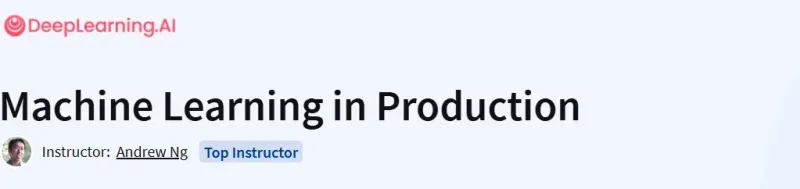
Machine Learning in Production Course

Machine Learning in Production Course Course

"Introduction to Machine Learning in Production" offers comprehensive training for individuals aiming to bridge the gap between machine learning theory and practical deployment. It's particularly bene...

Explore This Course Quick Enroll Page
9.7/10 Highly Recommended

Machine Learning in Production Course on Coursera — "Introduction to Machine Learning in Production" offers comprehensive training for individuals aiming to bridge the gap between machine learning theory and practical deployment. It's particularly beneficial for professionals seeking to deepen their skills in production-level ML systems.

Pros

  • Developed and taught by Andrew Ng, a leading expert in AI and machine learning.
  • Includes hands-on projects using real-world scenarios for practical experience.
  • Flexible schedule allowing learners to progress at their own pace.

Cons

  • Requires a commitment of approximately 5 hours per week.
  • Intermediate-level course; prior knowledge of Python programming and machine learning fundamentals is recommended.

Machine Learning in Production Course Course

Platform: Coursera

Instructor: DeepLearning.AI

What you will learn in Machine Learning in Production Course

  • Design an end-to-end ML production system: project scoping, data requirements, modeling strategies, and deployment constraints.

  • Establish a model baseline, address concept drift, and prototype the development, deployment, and continuous improvement of a productionized ML application.

  • Build data pipelines by gathering, cleaning, and validating datasets.

​​​​​​​​​​

  • Implement feature engineering, transformation, and selection using tools like TensorFlow Extended.

  • Apply best practices and progressive delivery techniques to maintain a continuously operating production system.

Program Overview

Overview of the ML Lifecycle and Deployment
3 hours

  • Introduction to ML production systems, focusing on requirements, challenges, deployment patterns, and monitoring strategies.

Modeling Challenges and Strategies
4 hours

  • Covers model strategies, error analysis, handling different data types, and addressing class imbalance and skewed datasets.

Data Definition and Baseline
4 hours

  • Focuses on working with various data types, ensuring label consistency, establishing performance baselines, and discussing improvement strategies.

Get certificate

Job Outlook

  • Equips learners with practical skills for roles such as ML Engineer, Data Scientist, and AI Specialist.

  • Provides hands-on experience in deploying and maintaining ML systems in production environments.

  • Enhances qualifications for positions requiring expertise in MLOps and production-level machine learning applications.

Explore More Learning Paths

Take your engineering and management expertise to the next level with these hand-picked programs designed to expand your skills and boost your leadership potential.

Related Courses

Related Reading

Gain deeper insight into how project management drives real-world success:

FAQs

How much weekly commitment is realistic for working professionals?
Around 5 hours/week is typical, but flexible scheduling is allowed. Hands-on labs may take longer depending on experience. Can be completed in 4–6 weeks with steady effort. Professionals can stretch learning over 2–3 months if needed. Self-paced design makes it manageable alongside full-time work.
How is this course different from standard ML theory courses?
Less math-heavy, more focused on applied engineering. Prioritizes deployment, monitoring, and scaling over algorithms. Emphasizes system design rather than isolated models. Projects simulate production constraints you’d face at work. Complements, rather than replaces, theoretical ML courses.
Can this course help me shift into an MLOps career path?
Yes, it builds strong foundations for ML in production environments. Teaches lifecycle management from data to deployment. Reinforces DevOps-style thinking applied to ML systems. Equips you for roles like ML Engineer, MLOps Specialist, or AI Engineer. Adds credibility when applying for production-focused ML jobs.
How does this course prepare me for real-world ML engineering?
Teaches how to move models from Jupyter notebooks into production. Focuses on deployment constraints, monitoring, and scalability. Covers handling data drift and continuous improvement. Includes end-to-end project design beyond just training models. Uses tools relevant to industry MLOps pipelines.
Do I need to be a machine learning expert before starting?
No expert knowledge required, but Python and basic ML fundamentals are expected. Familiarity with supervised learning and model evaluation helps. Prior exposure to libraries like scikit-learn/TensorFlow is useful. Beginners may need extra prep time on core ML concepts. Course is designed to bridge theory with practical deployment.

Similar Courses

Other courses in Data Science Courses