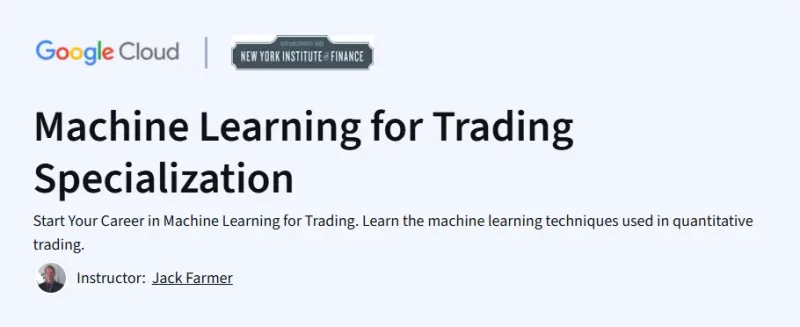
Machine Learning for Trading Specialization Course

Machine Learning for Trading Specialization Course Course

This specialization offers a broad overview of ML and RL applied to trading, with hands-on support. However, the depth varies across modules, and real-world strategy deployment requires further effort...

Explore This Course Quick Enroll Page
9.7/10 Highly Recommended

Machine Learning for Trading Specialization Course on Coursera — This specialization offers a broad overview of ML and RL applied to trading, with hands-on support. However, the depth varies across modules, and real-world strategy deployment requires further effort.

Pros

  • Covers multiple ML techniques oriented toward real trading use-cases.
  • Includes both traditional ML and RL strategy development.
  • Aligned with industry workflows using Python, backtesting, and GCP.

Cons

  • Limited practical implementation in later parts: some learners report purely theoretical RL sections with few coding tasks.
  • Mixed reviews on coherence—some feel it's more marketing-focused than execution-focused.

Machine Learning for Trading Specialization Course Course

Platform: Coursera

Instructor: Google

What will you learn in Machine Learning for Trading Specialization Course

  • Apply ML techniques like supervised learning, time-series forecasting, and TensorFlow/Keras for quantitative trading.

  • Build scalable model pipelines using Google Cloud Platform for trading strategy development.

​​​​​​​​​​

  • Create backtesting frameworks and deploy reinforcement learning (RL) agents for trading tasks.

  • Analyze financial patterns to craft momentum, statistical, and pairs trading strategies.

Program Overview

Module 1: Introduction to Trading, ML & GCP

⏳ 5 hours

  • Topics: Trading basics—trend, returns, stop‑loss, volatility—and quantitative strategy types (e.g. arbitrage).

  • Hands-on: Build basic ML models in Jupyter/GCP.

Module 2: Using ML in Trading and Finance

⏳ ~18 hours

  • Topics: Exploratory analysis, creating momentum/pairs trading models, using Keras/TensorFlow.

  • Hands-on: Backtest strategies; build ML models with Python.

Module 3: Reinforcement Learning for Trading Strategies

⏳ ~15 hours

  • Topics: RL concepts like policy/value functions; LSTM applications for time-series.

  • Hands-on: Design RL-based trading agents.

Get certificate

Job Outlook

  • Valuable for roles in quantitative trading, algorithmic development, and data-driven finance. Skills in ML, RL, and trading systems are highly sought after.

  • Intended for finance and ML professionals—intermediate Python, statistics, and financial knowledge required.

Explore More Learning Paths

Advance your machine learning and trading skills with these curated courses, designed to help you apply AI models to financial markets and real-world trading scenarios.

Related Courses

Related Reading

  • What Is Python Used For – Discover how Python powers machine learning, data analysis, and financial modeling in trading systems.
FAQs

Do I need prior finance or trading experience to take this specialization?
Basic financial or trading knowledge is helpful but not mandatory. The course introduces trading concepts like momentum, pairs trading, and arbitrage. Focuses on ML, RL, and Python for strategy development. Beginners in trading may need extra time to understand domain-specific examples. Practical application is reinforced through backtesting and model-building labs.
How hands-on is the course for implementing trading strategies?
Labs cover building ML models using Python and GCP. Backtesting frameworks allow experimentation with real trading data. RL-based strategy sections are more theoretical with fewer coding exercises. Encourages independent implementation for real-world deployment. Focuses on skills transferable to quantitative trading roles.
What careers can this specialization prepare me for?
Prepares for roles like Quantitative Analyst, Algorithmic Trader, or ML Engineer. Builds skills for designing ML-driven trading strategies. Enhances employability in finance and fintech industries. Reinforces portfolio with practical backtesting and Python projects. Valuable for professionals seeking intermediate ML and finance integration.
Does the course cover reinforcement learning in depth?
Introduces policy/value functions and LSTM applications for time-series. RL labs may be limited in coding exercises. Some RL concepts are more theoretical than hands-on. Learners are encouraged to build independent RL projects. Serves as a foundation for advanced RL-based trading implementation.
How long should I realistically plan to complete this specialization?
Total estimated duration is ~38 hours across modules. Module 2 (ML in trading) is the most time-intensive (~18 hours). RL module takes ~15 hours with extra study needed for coding practice. Additional time may be needed for independent backtesting projects. Part-time learners can complete it in 6–8 weeks; focused learners in 3–4 weeks.

Similar Courses

Other courses in Data Science Courses