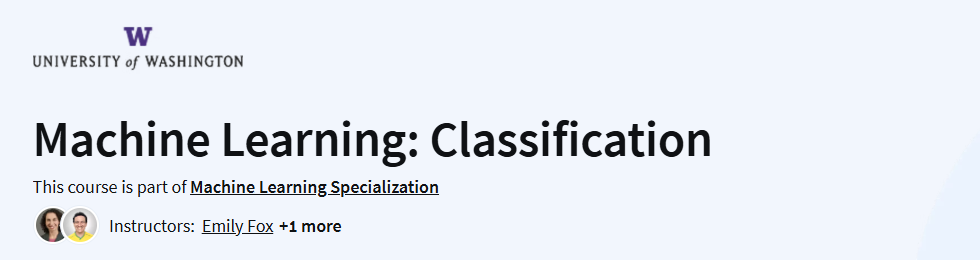
What will you in the Machine Learning: Classification Course
-
Understand how classification models work and where they are applied.
-
Implement logistic regression for binary and multi-class problems.
-
Build and interpret decision trees and apply boosting for improved performance.
-
Use stochastic gradient ascent to handle large datasets.
-
Evaluate models with metrics such as precision and recall
Program Overview
Module 1: Introduction to Classification
Duration: ~1 hour
-
Overview of classification and real-world use cases.
-
Introduction to the tools and data used in the course.
Module 2: Linear Classifiers and Logistic Regression
Duration: ~3 hours
-
Implement logistic regression from scratch.
-
Explore class boundaries, gradient ascent, and feature selection.
-
Handle multi-class problems using one-vs-all classification.
Module 3: Decision Trees
Duration: ~3 hours
-
Understand how decision trees split data based on feature values.
-
Learn tree construction, stopping rules, and overfitting prevention.
-
Apply decision trees to structured and unstructured data.
Module 4: Boosting for Classification
Duration: ~2 hours
-
Introduction to ensemble learning and boosting techniques.
-
Learn how to improve weak learners to build a strong classifier.
Module 5: Scaling With Stochastic Gradient Ascent
Duration: ~2 hours
-
Use stochastic methods to handle massive datasets efficiently.
-
Learn convergence techniques and optimization strategies.
Module 6: Handling Missing Data and Model Evaluation
Duration: ~2 hours
-
Techniques to manage incomplete data inputs.
-
Evaluate models with accuracy, precision, recall, and ROC curves.
Get certificate
Job Outlook
-
Machine Learning Engineers: Apply scalable classification models in production systems.
-
Data Scientists: Build predictive models for business, healthcare, or finance sectors.
-
Software Developers: Implement classification-based features in intelligent applications.
-
AI Researchers: Use classification foundations in academic and product-focused research.
-
Marketing & Risk Analysts: Predict churn, detect fraud, or assess risk using classification methods.
Explore More Learning Paths
Enhance your classification and machine learning expertise with these carefully curated courses designed to help you build predictive models and analyze complex datasets.
Related Courses
-
Machine Learning with Python Course – Learn to implement machine learning algorithms in Python and apply them to real-world datasets.
-
Machine Learning for All Course – Gain a broad understanding of machine learning concepts and their applications, suitable for all skill levels.
-
Applied Machine Learning in Python Course – Develop hands-on skills to build, evaluate, and deploy machine learning models using Python.
Related Reading
-
What Is Data Management? – Explore data management practices that support accurate and efficient machine learning analysis.