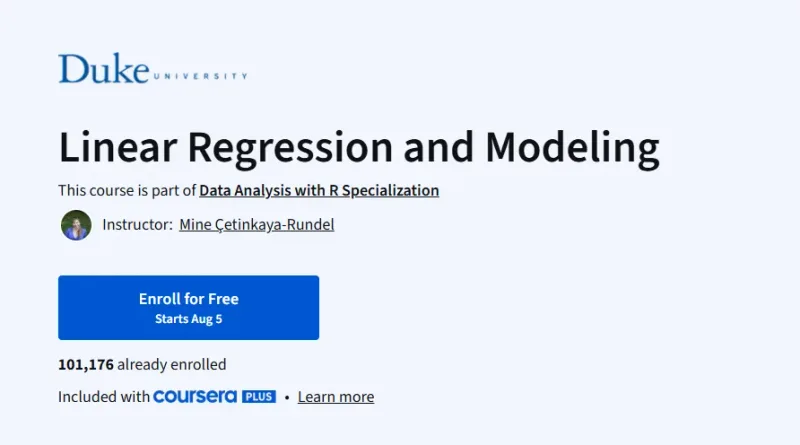
What will you learn in Linear Regression and Modeling Course
-
Understand the fundamentals of linear regression and its assumptions
-
Use regression models to analyze relationships between variables
-
Interpret regression coefficients and determine model validity
-
Apply regression analysis in real-world business scenarios
-
Use Excel to build and evaluate regression models
Program Overview
Module 1: Introduction to Linear Regression
⏳ 1 week
-
Topics: Dependent vs. independent variables, scatterplots, correlation
-
Hands-on: Building your first regression model in Excel
Module 2: Estimating the Regression Line
⏳ 1 week
-
Topics: Ordinary Least Squares (OLS), residuals, best-fit line
-
Hands-on: Calculating regression line by hand and Excel practice
Module 3: Evaluating the Model
⏳ 1 week
-
Topics: R², adjusted R², hypothesis testing for regression coefficients
-
Hands-on: Model interpretation and evaluating model strength
Module 4: Model Assumptions and Diagnostics
⏳ 1 week
-
Topics: Linearity, independence, homoscedasticity, normality
-
Hands-on: Residual analysis and model refinement
Module 5: Business Applications of Regression
⏳ 1 week
-
Topics: Forecasting, marketing analysis, pricing strategy
-
Hands-on: Real-world business case studies and regression modeling
Get certificate
Job Outlook
-
Linear regression is a core technique in data science, business analytics, and finance
-
In-demand for roles such as business analyst, data analyst, and financial modeler
-
Salary ranges for analysts with regression skills: $65,000–$110,000/year
-
Applicable in industries like retail, banking, marketing, and consulting
Explore More Learning Paths
Enhance your data analysis and predictive modeling skills with these courses, designed to help you apply regression techniques to real-world datasets and business problems.
Related Courses
-
Machine Learning: Regression Course – Learn how to implement regression algorithms and predictive models for practical data science applications.
-
Supervised Machine Learning: Regression and Classification Course – Explore supervised learning techniques, including regression and classification, to make data-driven predictions.
-
Linear Regression for Business Statistics Course – Apply linear regression methods to business data to derive insights and support decision-making.
Related Reading
-
What Is Data Management? – Understand the importance of organizing, processing, and analyzing data effectively to ensure accurate and actionable insights.