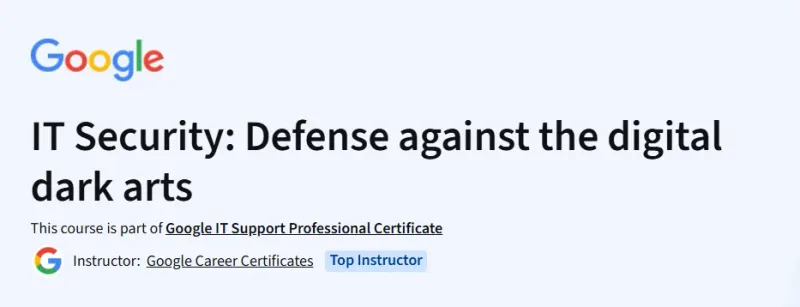
What will you learn in IT Security: Defense against the digital dark arts Course
-
Master core IT security concepts: threats, vulnerabilities, and defensive strategies within the CIA triad.
-
Understand encryption algorithms (symmetric, asymmetric, hashing) and their practical use-cases.
-
Learn authentication, authorization, accounting (AAA) systems and how they support secure access.
-
Explore network security tools—firewalls, Wi‑Fi encryption—and layered defense architectures.
Program Overview
Module 1: Understanding Security Threats
⏳ ~4 hours
-
Topics: Threat, vulnerability, risk; malware, network attacks, DOS/DDOS, client-side and password-based exploits, deception techniques.
-
Hands-on: 10 videos (~35 min), 7 readings (~70 min), 4 lab assignments, and 2 discussion prompts.
Module 2: Cryptography Fundamentals
⏳ ~5–7 hours
-
Topics: Symmetric vs asymmetric encryption, hashing algorithms, cryptographic use cases, limitations.
-
Hands-on: Videos, readings covering core algorithms; assignments applying encryption in simulated scenarios.
Module 3: Authentication, Authorization & Accounting (AAA)
⏳ ~4 hours
-
Topics: Identity management systems, access control models, authorization workflows, accounting/logging practices.
-
Hands-on: Quizzes and practical exercises implementing AAA principles.
Module 4: Network Security Solutions
⏳ ~4 hours
-
Topics: Firewalls, VPNs, Wi‑Fi encryption standards, network segmentation and layered defensive techniques.
-
Hands-on: Labs configuring secure network settings and encrypting wireless communications.
Module 5: Building Security Architecture & Culture
⏳ ~3 hours
-
Topics: Designing multi-layered (defense-in-depth) architectures, integrating security into organizational processes, promoting security awareness culture.
-
Hands-on: Quizzes, scenario-based assignments applying secure architecture patterns and policy recommendations.
Module 6: Course Wrap-Up & Best Practices
⏳ ~2 hours
-
Topics: Key takeaways, next steps in IT security career progression, aligning with professional certifications.
-
Hands-on: Final recap quizzes and reflection assignments.
Get certificate
Job Outlook
-
This course equips learners for roles like IT Support Specialists, Junior Security Administrators, and Help Desk Technicians. It forms a foundation for advanced certs such as CompTIA Security+ or Google Cybersecurity.
Skills gained help with common SOC tasks, network hardening, identity governance, and incident planning.
Explore More Learning Paths
Strengthen your cybersecurity expertise with these carefully curated courses, designed to help you defend systems, manage risks, and build a strong foundation in IT security.
Related Courses
-
Cybersecurity Fundamentals Specialization Course – Learn the core principles of cybersecurity, including network security, cryptography, and threat analysis.
-
Cybersecurity for Business Specialization Course – Understand how to protect business assets and information, while implementing practical security measures in a corporate setting.
-
Computer Security and Systems Management Specialization Course – Gain hands-on skills in securing computer systems, managing vulnerabilities, and responding to cyber threats effectively.
Related Reading
-
What Is Management Consulting – Explore how consulting strategies can integrate IT security solutions into organizational decision-making and operations.