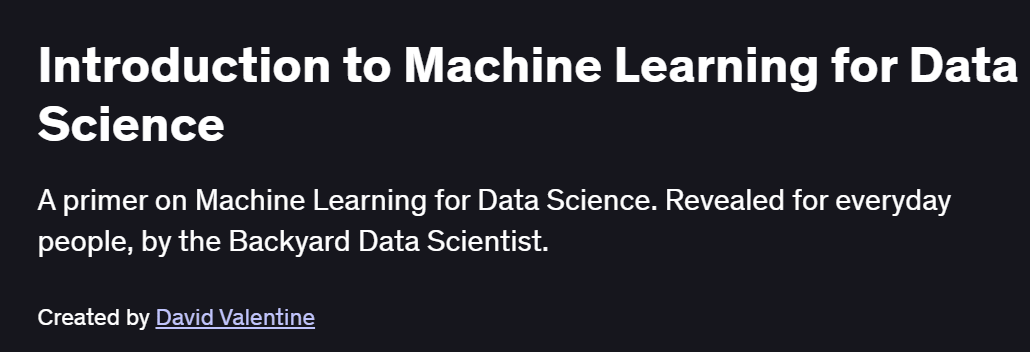
What will you in Introduction to Machine Learning for Data Science Course
-
Grasp core machine learning concepts: supervised vs. unsupervised learning, overfitting, and model evaluation
-
Implement algorithms such as linear regression, logistic regression, decision trees, and k-means clustering
-
Preprocess data: handling missing values, feature scaling, encoding categorical variables, and dimensionality reduction
-
Evaluate model performance using metrics (MSE, accuracy, precision, recall, F1-score) and cross-validation
-
Deploy trained models with simple pipelines and understand basic considerations for productionization
Program Overview
Module 1: Introduction & Environment Setup
⏳ 30 minutes
-
Installing Python, Jupyter Notebook, and key libraries (scikit-learn, pandas, matplotlib)
-
Overview of the ML workflow and dataset exploration
Module 2: Data Preprocessing & Feature Engineering
⏳ 1 hour
-
Handling missing data, outliers, and normalization/standardization
-
Creating new features, encoding categoricals, and dimensionality reduction (PCA)
Module 3: Supervised Learning – Regression
⏳ 1 hour
-
Implementing linear and polynomial regression with scikit-learn
-
Assessing model fit, regularization techniques (Ridge, Lasso), and bias-variance trade-off
Module 4: Supervised Learning – Classification
⏳ 1 hour
-
Training logistic regression, k-nearest neighbors, and decision tree classifiers
-
Hyperparameter tuning with grid search and evaluating with confusion matrices
Module 5: Unsupervised Learning
⏳ 45 minutes
-
Applying k-means clustering and hierarchical clustering for segmentation
-
Using Gaussian mixture models and silhouette scores for cluster validation
Module 6: Ensemble Methods & Advanced Models
⏳ 1 hour
-
Boosting (AdaBoost, Gradient Boosting) and bagging (Random Forest) techniques
-
Understanding feature importance and improving model robustness
Module 7: Model Evaluation & Validation
⏳ 45 minutes
-
Cross-validation strategies, learning curves, and ROC/AUC analysis
-
Addressing class imbalance with resampling and metric selection
Module 8: Deployment & Best Practices
⏳ 30 minutes
-
Building a simple prediction pipeline and saving models with joblib
-
Key considerations for production: latency, monitoring, and data drift
Get certificate
Job Outlook
-
Machine learning expertise is highly sought for roles such as Data Scientist, ML Engineer, and AI Specialist
-
Applicable in industries from finance and healthcare to tech and e-commerce for predictive analytics
-
Foundation for advanced topics: deep learning, NLP, computer vision, and big-data frameworks
-
Opens pathways to research, product development, and leadership in data-driven organizations
Explore More Learning Paths
Enhance your data science and machine learning skills with these expertly curated courses, designed to help you progress from foundational concepts to hands-on model building and real-world applications.
Related Courses
-
IBM Introduction to Machine Learning Specialization Course – Gain a comprehensive understanding of machine learning algorithms, workflows, and practical implementation in Python.
-
Machine Learning for All Course – Learn machine learning concepts in an accessible, beginner-friendly format without requiring a deep math or programming background.
-
Applied Machine Learning in Python Course – Apply Python to solve real-world problems using supervised and unsupervised machine learning techniques.
Related Reading
-
What Is Python Used For? – Explore Python’s role in data science, machine learning, and AI-driven solutions across industries.