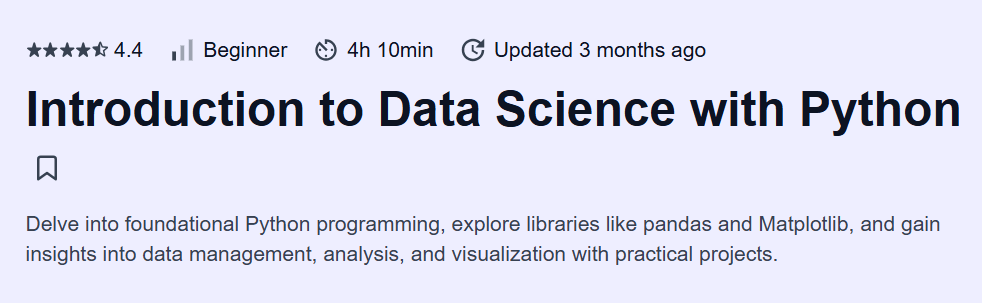
What will you learn in Introduction to Data Science with Python Course
-
Utilize Python’s data ecosystem: NumPy for arrays, pandas for DataFrames, and Matplotlib/Seaborn for visualization
-
Perform data ingestion, cleaning, and transformation on real-world datasets
-
Apply exploratory data analysis (EDA) techniques to uncover patterns and insights
-
Implement fundamental statistical methods: descriptive stats, hypothesis testing, and regression
-
Build and evaluate simple machine learning models (e.g., linear regression, decision trees) with scikit-learn
Program Overview
Module 1: Python for Data Science Setup
⏳ 1 week
-
Topics: Conda environments, Jupyter notebooks, Python basics refresher
-
Hands-on: Configure your environment and load CSV/JSON data into pandas
Module 2: Numerical Computing with NumPy
⏳ 1 week
-
Topics: ndarray operations, broadcasting, vectorized computations
-
Hands-on: Analyze large numeric arrays for summary statistics and transformations
Module 3: Data Wrangling with pandas
⏳ 1 week
-
Topics: DataFrame creation, indexing, grouping, merging, and pivot tables
-
Hands-on: Clean and reshape a messy dataset with missing values and inconsistent formats
Module 4: Data Visualization
⏳ 1 week
-
Topics: Matplotlib fundamentals, Seaborn plot types, customizing aesthetics
-
Hands-on: Create histograms, boxplots, heatmaps, and multi-facet visualizations to tell a story
Module 5: Exploratory Data Analysis (EDA)
⏳ 1 week
-
Topics: Outlier detection, correlation analysis, feature engineering basics
-
Hands-on: Perform end-to-end EDA on a public dataset to identify key drivers and relationships
Module 6: Statistics for Data Science
⏳ 1 week
-
Topics: Descriptive statistics, probability distributions, confidence intervals, t-tests
-
Hands-on: Test hypotheses (e.g., A/B test scenario) and interpret p-values
Module 7: Introduction to Machine Learning
⏳ 1 week
-
Topics: Supervised learning workflow, train/test split, regression vs. classification, overfitting
-
Hands-on: Build and evaluate a linear regression and a decision-tree classifier using scikit-learn
Module 8: Capstone Project
⏳ 1 week
-
Topics: Problem scoping, model selection, performance metrics, storytelling with insights
-
Hands-on: Complete a mini data science project: from data ingestion through model deployment mock-up
Get certificate
Job Outlook
-
Data science skills with Python are in high demand for roles like Data Analyst, Junior Data Scientist, and Business Intelligence Developer
-
Industries span finance, healthcare, e-commerce, and tech startups, with entry-level salaries typically $70,000–$90,000
-
Foundational knowledge opens pathways to advanced specializations in machine learning, deep learning, and big data engineering
Explore More Learning Paths
Enhance your data science skills with these hand-picked programs designed to help you analyze, interpret, and visualize data using Python and modern analytical tools.
Related Courses
-
Applied Data Science with Python Specialization by University of Michigan Course – Learn to apply Python to data analysis, visualization, and machine learning through hands-on projects and real-world datasets.
-
Introduction to Data Science in Python Course – Gain foundational Python programming and data science skills to manipulate, analyze, and draw insights from data.
-
Databases and SQL for Data Science with Python Course – Master SQL and Python integration for querying databases, managing data, and supporting analytical workflows.
Related Reading
Gain deeper insight into how structured knowledge enhances data science workflows:
-
What Is Knowledge Management? – Understand how organizing and leveraging data science knowledge improves analysis, decision-making, and project outcomes.