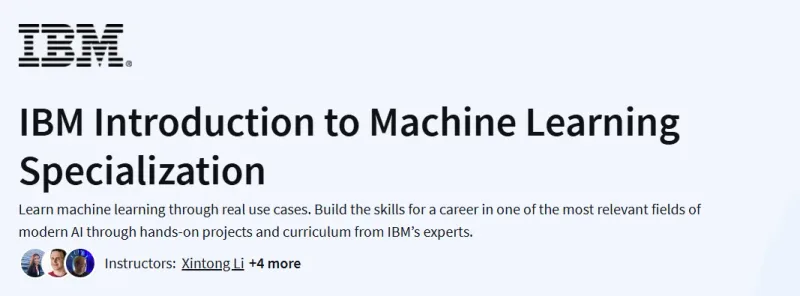
What will you learn in this IBM Introduction to Machine Learning Specialization Course
-
Understand the fundamentals of machine learning and its applications in various industries.
-
Perform exploratory data analysis, including data retrieval, cleaning, and feature engineering.
-
Implement supervised learning techniques such as regression and classification.
-
Apply unsupervised learning methods, including clustering and dimensionality reduction.
-
Develop practical skills through hands-on projects using real-world datasets.
Program Overview
1. Exploratory Data Analysis for Machine Learning
⏳ 14 hours
Learn to retrieve data from various sources, clean and preprocess it, and perform feature engineering to prepare for machine learning models.
2. Supervised Learning: Regression
⏳ 14 hours
Delve into regression techniques, including linear regression, ridge regression, and LASSO, to predict continuous outcomes.
3. Supervised Learning: Classification
⏳ 14 hours
Explore classification algorithms such as logistic regression, decision trees, and support vector machines to categorize data.
4. Unsupervised Learning
⏳ 14 hours
Understand clustering methods like K-means and hierarchical clustering, as well as dimensionality reduction techniques like PCA
Get certificate
Job Outlook
-
Equips learners for roles such as Machine Learning Engineer, Data Scientist, and AI Analyst.
-
Applicable in industries like technology, healthcare, finance, and e-commerce.
-
Enhances employability by providing practical skills in machine learning and data analysis.
-
Supports career advancement in fields requiring expertise in predictive modeling and data-driven decision-making.
Explore More Learning Paths
Strengthen your machine learning foundation with these carefully curated programs designed to help you understand core concepts, structure real-world ML projects, and build practical modeling skills. Whether you’re a beginner or advancing your expertise, these courses will guide you toward confident ML development and problem-solving.
Related Courses
-
Machine Learning for All Course
A beginner-friendly introduction to how machine learning works, perfect for learners without a technical background who want to understand core ML ideas. -
Structuring Machine Learning Projects Course
Learn how to manage ML projects effectively, avoid common development pitfalls, and apply industry-tested strategies for building scalable systems. -
Applied Machine Learning in Python Course
Gain hands-on experience implementing ML models using Python, focusing on practical techniques for data preparation, model evaluation, and improvement.
Related Reading
-
What Is Knowledge Management?
Understand how structured information, data organization, and systematic learning support more efficient machine learning workflows.