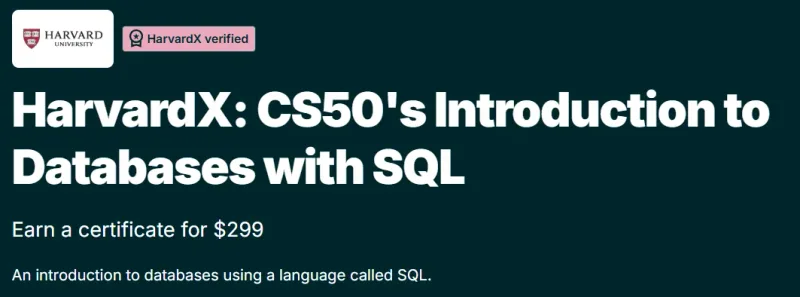
What will you learn in HarvardX: CS50’s Introduction to Databases with SQL course
-
Understand how relational databases work and why they are critical to modern software and data systems.
-
Learn SQL fundamentals to create, read, update, and delete data (CRUD operations).
-
Design efficient database schemas using tables, primary keys, and foreign keys.
-
Write complex SQL queries using joins, subqueries, and aggregations.
-
Understand indexes, constraints, and transactions for performance and data integrity.
-
Apply database concepts through practical, CS50-style problem sets.
Program Overview
Databases and SQL Fundamentals
⏳ 1–2 weeks
-
Learn what databases are and how they differ from spreadsheets.
-
Understand tables, rows, columns, and keys.
-
Write basic SQL queries using SELECT, INSERT, UPDATE, and DELETE.
Relational Design and Normalization
⏳ 2–3 weeks
-
Learn how to design normalized database schemas.
-
Understand relationships between tables using foreign keys.
-
Avoid redundancy and maintain data consistency.
Advanced Queries and Joins
⏳ 2–3 weeks
-
Use INNER JOIN, LEFT JOIN, and nested queries.
-
Aggregate data using GROUP BY and HAVING.
-
Query real-world-style datasets efficiently.
Indexes, Constraints, and Transactions
⏳ 2–3 weeks
-
Learn how indexes improve query performance.
-
Apply constraints such as UNIQUE and CHECK.
-
Understand transactions, atomicity, and concurrency.
Applied Database Problem Sets
⏳ 2–3 weeks
-
Solve practical database challenges inspired by real applications.
-
Strengthen query-writing and schema-design skills.
-
Build confidence using SQL in production-like scenarios.
Get certificate
Job Outlook
-
Core skill for Software Engineers, Backend Developers, and Data Analysts.
-
Essential for roles such as Database Developer, Data Engineer (Junior), and Full-Stack Developer.
-
Widely used across industries including tech, finance, healthcare, and analytics.
-
Strong foundation for advanced topics like data engineering, system design, and backend development.
Explore More Learning Paths
Strengthen your database and SQL skills with these curated courses designed to help you design efficient databases, write queries, and manage data effectively.
Related Courses
-
Generative AI SQL Database Specialist with ChatGPT Specialization Course – Learn how to combine SQL skills with AI tools to manage and analyze complex datasets efficiently.
-
Databases and SQL for Data Science with Python Course – Explore how to use SQL and Python together for data analysis and database management.
-
Using Databases with Python Course – Master database connectivity and query execution using Python to build data-driven applications.
Related Reading
-
What Is Data Management? – Understand the principles of managing data efficiently and the importance of database design in data-driven decision-making.