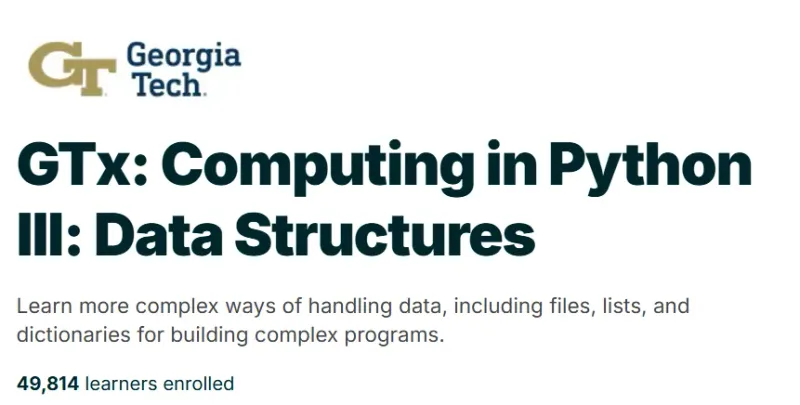
What will you learn in GTx: Computing in Python III: Data Structures course
- This course provides a structured introduction to core data structures in Python, building on foundational programming knowledge.
- Learners will understand how data structures organize, store, and manage information efficiently in software applications.
- The course emphasizes practical implementation of lists, dictionaries, sets, tuples, stacks, queues, and trees.
- Students will explore algorithmic thinking, complexity analysis, and performance trade-offs.
- Hands-on coding exercises help reinforce problem-solving skills and efficient program design.
- By the end of the course, participants will gain strong technical skills required for software development and technical interviews.
Program Overview
Core Python Data Structures
⏳ 2–3 Weeks
- Understand lists, tuples, dictionaries, and sets.
- Learn how to manipulate and access structured data efficiently.
- Explore built-in methods and practical use cases.
- Develop confidence in data organization.
Abstract Data Types (ADTs)
⏳ 2–3 Weeks
- Study stacks, queues, and linked lists.
- Understand how abstract data types improve program structure.
- Implement common data structures in Python.
- Analyze when and why to use specific structures.
Trees and Graph Basics
⏳ 2–3 Weeks
- Explore hierarchical data representation.
- Understand tree traversal techniques.
- Learn graph fundamentals and simple search algorithms.
- Apply structures to real-world modeling problems.
Algorithmic Thinking & Efficiency
⏳ 2–3 Weeks
- Study time and space complexity (Big-O notation).
- Analyze performance trade-offs between structures.
- Optimize code using efficient data handling.
- Prepare for technical coding interviews.
Get certificate
Job Outlook
- Data structure knowledge is fundamental for careers in software development, backend engineering, data engineering, and computer science research.
- Professionals skilled in Python and algorithmic thinking are sought for roles such as Software Developer, Backend Engineer, Data Engineer, and Machine Learning Engineer.
- Entry-level software developers typically earn between $80K–$105K per year, while experienced engineers can earn $120K–$170K+ depending on industry and region.
- Strong understanding of data structures is critical for technical interviews at leading technology companies.
- This course provides a solid foundation for advanced computer science and algorithm-focused learning paths.