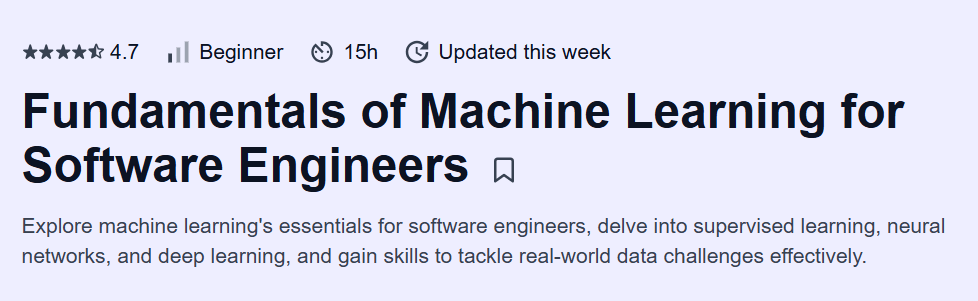
What will you learn in Fundamentals of Machine Learning for Software Engineers Course
- Core ML concepts for engineers: Supervised vs unsupervised learning, neural networks, deep learning architectures.
- Hands-on model building: Implement linear regression, gradient descent, and neural nets using real-world datasets.
- Bridge coding vs ML: Learn how ML focuses on behavior programming instead of explicit logic; design models accordingly.
- Data engineering skills: Preprocess and work with complex datasets, ensuring robustness in your ML pipelines.
- Neural net expertise: Build single-layer and deep neural networks yourself, not just use APIs.
Program Overview
Module 1: How Machine Learning Works
⏳ ~30 minutes
-
Topics: Introduction to ML paradigms, supervised vs unsupervised, and basic neural nets.
-
Hands-on: Explore ML workflows and compare traditional vs ML-based code patterns.
Module 2: Our First Learning Program (Linear Regression)
⏳ ~1 hour
-
Topics: Linear regression model design, bias term, and learning rate adjustments.
-
Hands-on: Build, train, and test a linear regression model on real data.
Module 3: Walking the Gradient (Gradient Descent)
⏳ ~45 minutes
-
Topics: Understand gradient descent, parameter optimization, and convergence behavior.
-
Hands-on: Implement gradient descent manually, tune learning rates, and visualize training.
Module 4: Neural Networks
⏳ ~1.5 hours
-
Topics: Components of an artificial neuron, activation functions, forward/backward pass mechanics.
-
Hands-on: Code a simple neural network from scratch, train on sample sets.
Module 5: Deep Learning (Layered Nets)
⏳ ~1.5 hours
-
Topics: Multi-layer networks, backpropagation, and basic deep learning design principles.
-
Hands-on: Extend your neural net with additional layers and train on more complex data.
Module 6: Putting It All Together
⏳ ~1 hour
-
Topics: ML pipeline integration, model versioning, and real-world deployment considerations.
-
Hands-on: Wrap up with a project that processes data end-to-end and deploys a model.
Get certificate
Job Outlook
- High-value skillset: ML expertise enhances your toolkit as a software engineer, unlocking data-centric roles.
- Career advancement: Prepares you for positions such as ML Engineer, AI Backend Developer, or Data Engineer.
- Future-readiness: Equips you to contribute to modern AI systems and distributed model deployment.
- Startup & freelance potential: Build and customize lightweight ML solutions for various businesses.
Explore More Learning Paths
Take your engineering and management expertise to the next level with these hand-picked programs designed to expand your skills and boost your leadership potential.
Related Courses
-
Generative AI for Software Developers Specialization – Learn to integrate generative AI into software systems and build intelligent applications using modern AI tools and frameworks.
-
Machine Learning Specialization – Master the core principles of machine learning, including supervised and unsupervised learning, and gain hands-on experience with real-world datasets.
-
Machine Learning with Big Data – Understand how to scale machine-learning workflows and work with massive datasets using distributed computing technologies.
Related Reading
-
What Is Data Management? – Learn the fundamentals of organizing, storing, and governing data effectively—key knowledge for building reliable machine-learning systems.