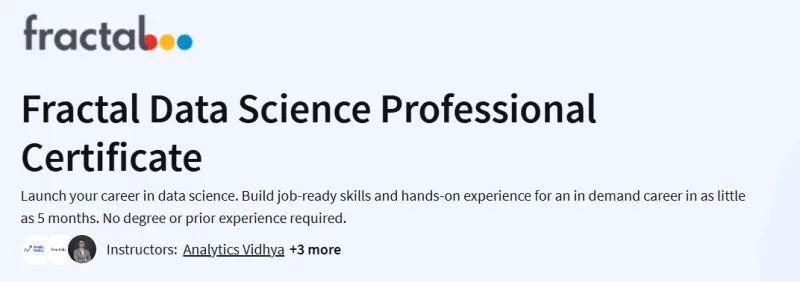
What you will learn in Fractal Data Science Professional Certificate Course
- Structured Problem-Solving Techniques: Develop a systematic approach to tackling complex data science problems, emphasizing human-centric design and avoiding common pitfalls.
- Data Analysis Using SQL: Acquire proficiency in SQL for efficient data extraction, manipulation, and analysis, enabling you to handle large datasets effectively.
- Python Programming for Data Science: Learn to use Python for data analysis, including data manipulation, statistical analysis, and building predictive models.
- Data Visualization with Power BI: Gain skills in creating compelling data visualizations and dashboards using Power BI to communicate insights clearly.
- Machine Learning Foundations and Advanced Algorithms: Understand the principles of machine learning and delve into advanced algorithms to build predictive models.
- Data Storytelling and Decision-Making: Learn to craft narratives around data findings to inform and influence business decisions effectively.
Program Overview
Fundamentals of Quantitative Modeling
⏱️ 4-6 weeks
Build foundational knowledge of quantitative modeling, including model design and practical implementation in Excel.
-
Learn how models support decision-making in finance and business.
-
Understand best practices for structuring, documenting, and testing models.
-
Apply basic math and statistical tools used in financial analysis.
-
Explore model inputs, assumptions, and output interpretation.
Introduction to Spreadsheets and Models
⏱️ 4-6 weeks
This course teaches spreadsheet functionality with a focus on modeling and finance applications.
-
Develop key Excel skills such as cell referencing, conditional logic, and data analysis.
-
Construct financial models for budgeting, forecasting, and investment evaluation.
-
Learn spreadsheet auditing techniques and error detection methods.
-
Practice model versioning and collaboration in real-world environments.
Modeling Risk and Realities
⏱️ 6-8 weeks
Dive into financial risk modeling and develop techniques to manage uncertainty in forecasts.
-
Explore scenario and sensitivity analysis to assess model robustness.
-
Learn probabilistic modeling techniques and risk quantification.
-
Apply Monte Carlo simulations for advanced risk modeling.
-
Understand limitations and biases in financial models.
Decision-Making and Scenarios
⏱️ 6-8 weeks
Learn to apply models for strategic decision-making using financial data and forecasts.
-
Analyze capital budgeting decisions using Net Present Value (NPV) and Internal Rate of Return (IRR).
-
Understand how to model financing structures, interest rates, and capital allocation.
-
Use data-driven models to guide business decisions and strategy.
-
Present scenario-based outcomes to stakeholders using clear visuals and summaries.
Get certificate
Job Outlook
- The demand for finance professionals with quantitative modeling skills is rising, especially in fields like investment banking, equity research, and corporate finance.
- Analysts with financial modeling capabilities earn competitive salaries, with entry-level roles starting around $65K–$90K and senior roles exceeding $120K annually.
- Industries like fintech, consulting, and asset management increasingly seek data-driven decision-makers with strong modeling proficiency.
- Modeling skills improve career prospects for roles such as Financial Analyst, Investment Analyst, Business Intelligence Analyst, and Strategy Consultant.
- Quantitative modeling expertise provides a solid base for CFA, MBA, or further specialization in financial engineering.
- Employers value real-world Excel skills and the ability to communicate insights clearly using models and data.
- This specialization prepares learners for roles that require financial acumen, critical thinking, and advanced spreadsheet proficiency.
Explore More Learning Paths
Boost your data science expertise and strengthen your analytical problem-solving skills with these curated programs designed to provide a strong foundation and practical knowledge for real-world data projects.
Related Courses
-
What Is Data Science Course – Gain a comprehensive overview of data science, its applications, and key tools used in the field.
-
Foundations of Data Science Course – Build essential skills in data analysis, statistics, and programming to prepare for advanced data science projects.
-
Tools for Data Science Course – Learn to leverage industry-standard tools for data cleaning, analysis, visualization, and modeling.
Related Reading
Enhance your understanding of how organizations leverage data for decision-making and innovation:
-
What Is Data Management? – Explore the strategies and best practices for managing and organizing data effectively in modern enterprises.