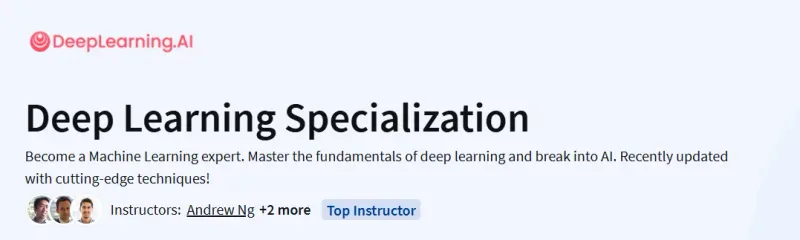
What will you learn in this Deep Learning Specialization
-
Build and train deep neural networks, implementing vectorized computations for efficiency.
-
Apply strategies like dropout, batch normalization, and Xavier/He initialization to improve model performance.
-
Develop convolutional neural networks (CNNs) for tasks such as image classification and object detection.
-
Construct recurrent neural networks (RNNs), including LSTMs and GRUs, for sequence modeling and natural language processing.
-
Utilize frameworks like TensorFlow and tools such as Hugging Face transformers for real-world applications.
-
Gain insights into structuring machine learning projects and making strategic decisions in AI development
Program Overview
Course 1: Neural Networks and Deep Learning
⏳ 4 weeks
- Learn the foundational concepts of neural networks and deep learning, including forward and backward propagation, and implement a neural network from scratch.
Course 2: Improving Deep Neural Networks: Hyperparameter Tuning, Regularization, and Optimization
⏳ 4 weeks
- Explore techniques to enhance neural network performance, such as hyperparameter tuning, regularization methods, and optimization algorithms like Adam and RMSprop.
Course 3: Structuring Machine Learning Projects
⏳ 2 weeks
- Understand how to diagnose errors in machine learning systems, prioritize strategies for improvement, and apply best practices in project structuring.
Course 4: Convolutional Neural Networks
⏳ 4 weeks
- Delve into CNN architectures and applications, including object detection, neural style transfer, and face recognition systems.
Course 5: Sequence Models
⏳ 4 weeks
- Learn about sequence modeling using RNNs, LSTMs, GRUs, and attention mechanisms, applying them to tasks like speech recognition and language modeling.
Get certificate
Job Outlook
-
Completing this specialization prepares you for roles such as Deep Learning Engineer, AI Specialist, or Machine Learning Engineer.
-
The skills acquired are applicable across various industries, including healthcare, finance, and autonomous systems.
-
Enhance your employability by gaining practical experience in building and deploying deep learning models.
Explore More Learning Paths
Take your deep learning expertise to the next level with these curated programs designed to strengthen your understanding of neural networks, frameworks, and real-world AI applications.
Related Courses
-
IBM Deep Learning with PyTorch, Keras, and TensorFlow Professional Certificate Course – Master the most widely used deep learning frameworks and build production-ready AI models.
-
Neural Networks and Deep Learning Course – Develop a strong foundation in neural network architectures, forward/backward propagation, and optimization techniques.
-
Introduction to TensorFlow for Artificial Intelligence, Machine Learning, and Deep Learning Course – Learn how to build and train deep learning models using TensorFlow through hands-on exercises.
Related Reading
-
What Is Project Management? – Understand the principles that make every great project a success story.