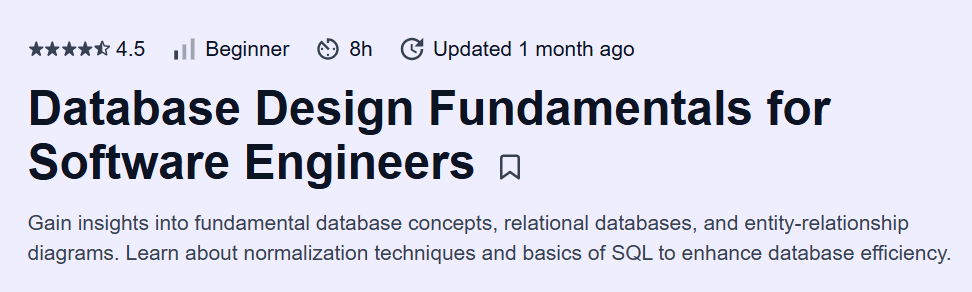
What will you learn in Database Design Fundamentals for Software Engineers Course
- Database fundamentals & modeling: Explore database properties, RDBMS architecture, and ER diagrams to model real-world systems.
- Normalization & integrity: Learn functional dependencies and apply 1NF–3NF normalization to ensure data consistency and minimize redundancy.
- Relational schema & SQL basics: Design relational schemas, choose keys, and perform CRUD operations with basic SQL commands.
- Design principles & best practices: Understand logical design decisions, database constraints, and introduction to performance-aware design.
- Hands-on design exercises: Build ERDs, refine schemas, normalize tables, and execute SQL statements in an interactive environment.
Program Overview
Module 1: Introduction to Databases
⏳ ~1 hour
-
Topics: Definition of databases, limitations of file-based systems, and core database properties.
-
Hands-on: Create basic DB examples and interact with console modules to explore dataset organization.
Module 2: Entity-Relationship Modeling
⏳ ~1.5 hours
-
Topics: ER model constructs: entity types, relationships, attributes, keys, weak entities, cardinality.
-
Hands-on: Design sample ER diagrams and map exercises to reinforce modeling principles.
Module 3: Relational Data Model & Schema Design
⏳ ~1 hour
-
Topics: Translate ER models to relational schemas, apply naming conventions, choose primary and foreign keys.
-
Hands-on: Create relational tables from ER diagrams and implement constraints in the editor.
Module 4: Normalization Techniques
⏳ ~1.5 hours
-
Topics: Study functional dependencies and apply 1NF, 2NF, and 3NF normalization rules.
-
Hands-on: Normalize unstructured schemas through interactive drills with community cases.
Module 5: Basic SQL Operations
⏳ ~1 hour
-
Topics: Execute
CREATE TABLE,INSERT,UPDATE,DELETE, and simpleSELECTqueries. -
Hands-on: Use SQL to manipulate and query tables built in earlier modules.
Module 6: Design Best Practices & Integrity
⏳ ~1 hour
-
Topics: Enforce referential integrity, use constraints, and discuss design trade-offs and decisions.
-
Hands-on: Implement constraints in schemas and analyze their effects on sample data operations.
Module 7: Case Study & Quiz
⏳ ~30 minutes
-
Topics: Apply full design cycle on a mini project: ER modeling, normalization, and SQL implementation.
-
Hands-on: Complete a capstone design exercise and assessment quiz to consolidate learning.
Get certificate
Job Outlook
- Core competence: Database design expertise is essential for backend, data engineering, and system architecture roles.
- High demand: Fundamental SQL and schema design skills are widely sought in software engineering.
- Foundation for scalability: Sets the stage for mastering performance tuning, NoSQL, and cloud data management.
- Portfolio value: Capstone exercises and ERDs showcase foundational skills to potential employers.
Explore More Learning Paths
Take your engineering and management expertise to the next level with these hand-picked programs designed to expand your skills and boost your leadership potential.
Related Courses
-
Generative AI for Software Development Skill Certificate – Learn how to integrate AI into software development workflows, enhance productivity, and build intelligent applications.
-
Introduction to Software Engineering – Gain a strong understanding of core software engineering principles, including design, testing, and development methodologies.
-
Applied Software Engineering Fundamentals Specialization – Build practical, real-world engineering skills through hands-on projects covering architecture, debugging, and scalable system design.
Related Reading
-
What Is Data Management? – Explore the principles of organizing, storing, and maintaining data effectively to support software systems and business operations.