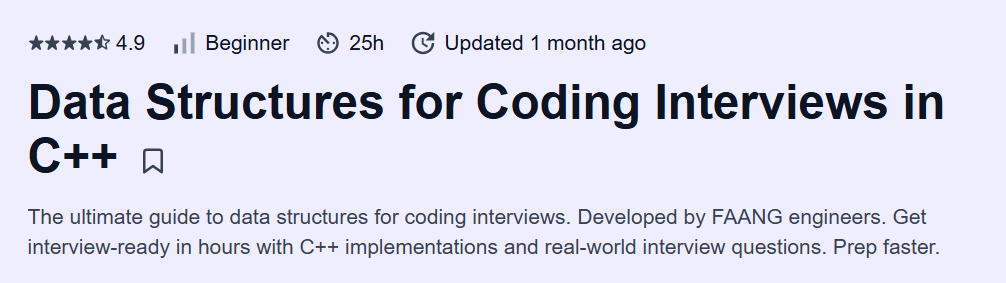
What will you learn in Data Structures for Coding Interviews in C++ Course
-
Master core data structures including arrays, linked lists, stacks, queues, trees, heaps, graphs, and hash maps using C++
-
Solve 150+ real-world coding interview questions with detailed explanations and optimal solutions
-
Learn algorithmic techniques like recursion, divide and conquer, sliding window, backtracking, and dynamic programming
-
Understand time and space complexity analysis for each approach to optimize your code
-
Build confidence in tackling technical interviews at FAANG and top tech companies through mock assessments and quizzes
Program Overview
Module 1: C++ Refresher
⏳ 2 hours
-
Topics: Pointers, references, dynamic memory, classes, STL (vectors, sets, maps)
-
Hands-on: Write C++ functions using vectors and hash maps; use STL containers in practice snippets
Module 2: Arrays & Strings
⏳ 3 hours
-
Topics: Traversals, two-pointer techniques, sliding window, frequency maps
-
Hands-on: Solve problems like “Longest Substring Without Repeating Characters” and “Container With Most Water”
Module 3: Linked Lists
⏳ 2.5 hours
-
Topics: Singly & doubly linked lists, fast-slow pointers, reversal, merge, cycle detection
-
Hands-on: Implement list reversal, detect loops, and merge sorted linked lists
Module 4: Stacks & Queues
⏳ 2 hours
-
Topics: Monotonic stacks, min/max stacks, circular queues, queue using stacks
-
Hands-on: Solve problems like “Daily Temperatures” and “Implement Queue Using Stacks”
Module 5: Trees & Binary Search Trees
⏳ 3.5 hours
-
Topics: DFS, BFS, tree traversals, balanced BSTs, diameter, serialization
-
Hands-on: Build a BST from preorder, find lowest common ancestor, and serialize/deserialize a tree
Module 6: Heaps & Priority Queues
⏳ 2 hours
-
Topics: Min-heap, max-heap, top-k elements, heap sort
-
Hands-on: Solve “K Closest Points to Origin” and implement heapify manually
Module 7: Recursion & Backtracking
⏳ 2 hours
-
Topics: Subsets, permutations, N-Queens, Sudoku solver
-
Hands-on: Code backtracking solutions and trace recursion trees step by step
Module 8: Hash Maps & Hash Sets
⏳ 2 hours
-
Topics: Collision handling, key-value pairs, frequency counters
-
Hands-on: Solve “Group Anagrams” and “Two Sum” using hash-based approaches
Module 9: Graphs & Traversals
⏳ 3 hours
-
Topics: BFS, DFS, topological sort, cycle detection, connected components
-
Hands-on: Implement graph traversals and solve “Course Schedule” and “Number of Islands”
Module 10: Dynamic Programming
⏳ 4 hours
-
Topics: Memoization, tabulation, state transition, DP on strings, grids, subsequences
-
Hands-on: Solve classics like “Longest Palindromic Substring,” “Edit Distance,” and “Knapsack”
Module 11: Final Interview Prep
⏳ 2 hours
-
Topics: Mock interviews, timed assessments, complexity review
-
Hands-on: Take simulated coding interviews and compare solutions with optimal approaches
Get certificate
Job Outlook
-
Strong demand for C++ developers in system-level programming, game development, finance, and embedded systems
-
Mastery of data structures and algorithms significantly boosts chances of cracking FAANG and Tier-1 interviews
-
Entry to mid-level roles offer $80,000–$140,000 annually; senior and competitive roles exceed $160,000
-
Useful for roles like Software Engineer, Systems Engineer, Competitive Programmer, and Game Developer
Explore More Learning Paths
Strengthen your coding interview preparation with these carefully selected courses designed to deepen your understanding of data structures and problem-solving skills in multiple programming languages.
Related Courses
-
Data Structures Course – Learn core data structures, algorithms, and their applications to solve real-world programming challenges.
-
Object-Oriented Data Structures in C Course – Gain hands-on experience implementing data structures using C, enhancing your understanding of object-oriented programming concepts.
-
Python Data Structures Course – Explore data structures using Python, providing a versatile perspective and helping you compare approaches across languages.
Related Reading
-
What Is Python Used For? – Understand Python’s versatility, complementing your C++ skills for coding interviews and software development roles.