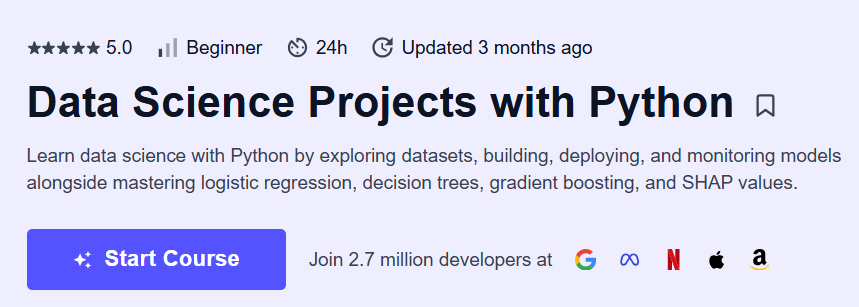
What will you learn in Data Science Projects with Python Course
-
Gain hands-on experience exploring, cleaning, and visualizing real-world datasets with pandas and Matplotlib
-
Build and evaluate logistic regression models, addressing overfitting through regularization and cross-validation
-
Train and tune decision tree and random forest classifiers to improve predictive accuracy
-
Master gradient boosting with XGBoost and interpret model outputs using SHAP values
Program Overview
Module 1: Introduction
⏳ 30 minutes
-
Topics: Role of ML in data science; essential Python libraries (pandas, scikit-learn)
-
Hands-on: Get set up in Jupyter, load the case-study data, and verify basic data integrity
Module 2: Data Exploration & Cleaning
⏳ 4 hours
-
Topics: Data-quality checks, handling missing values, categorical encoding
-
Hands-on: Perform end-to-end data cleaning and exploratory analysis on the credit dataset
Module 3: Introduction to scikit-learn & Model Evaluation
⏳ 3.5 hours
-
Topics: Synthetic data generation, train/test splitting, evaluation metrics (accuracy, ROC)
-
Hands-on: Train logistic regression, compute confusion matrix and ROC curve
Module 4: Details of Logistic Regression & Feature Extraction
⏳ 4 hours
-
Topics: Feature-response relationships, univariate selection (F-test), sigmoid function
-
Hands-on: Implement feature selection, plot decision boundaries, and interpret coefficients
Module 5: The Bias-Variance Trade-Off
⏳ 3.5 hours
-
Topics: Gradient descent optimization, L1/L2 regularization, cross-validation pipelines
-
Hands-on: Apply regularization techniques and hyperparameter tuning in scikit-learn
Module 6: Decision Trees & Random Forests
⏳ 3.25 hours
-
Topics: Tree-based learning, node impurity, hyperparameter grid search, ensemble methods
-
Hands-on: Train and tune decision tree and random forest models; visualize performance
Module 7: Gradient Boosting, XGBoost & SHAP Values
⏳ 3 hours
-
Topics: XGBoost hyperparameters (learning rate, early stopping), SHAP interpretability
-
Hands-on: Perform randomized grid search and generate SHAP explanations for case-study data
Module 8: Test-Set Analysis, Financial Insights & Delivery
⏳ 2.5 hours
-
Topics: Probability calibration, decile cost charts, business-impact analysis
-
Hands-on: Derive financial metrics (cost savings, ROI) and prepare client-ready deliverables
Module 9: Appendix – Local Jupyter Setup
⏳ 15 minutes
-
Topics: Recommended environment setup, Anaconda installation
-
Hands-on: Create and configure a local Jupyter Notebook for offline work
Get certificate
Job Outlook
-
Median annual wage for data scientists in the U.S.: $112,590
-
Projected data science job growth of 36% from 2023 to 2033, far outpacing average for all occupations
-
Roles include Data Scientist, ML Engineer, and Analytics Consultant across finance, healthcare, and tech
-
Expertise in end-to-end ML workflows unlocks opportunities in startups and enterprise data teams
Explore More Learning Paths
Enhance your Python and data science skills with these carefully selected courses designed to help you tackle real-world projects and strengthen your analytical capabilities.
Related Courses
-
Foundations of Data Science Course – Build a strong foundation in data science concepts, statistical analysis, and problem-solving techniques for practical applications.
-
Data Science Methodology Course – Learn the end-to-end data science workflow, including methodology and best practices for real-world project execution.
-
Tools for Data Science Course – Master essential tools and technologies for data analysis, visualization, and workflow optimization.
Related Reading
-
What Is Data Management – Understand how effective data management supports analytics, project execution, and decision-making in data-driven organizations.