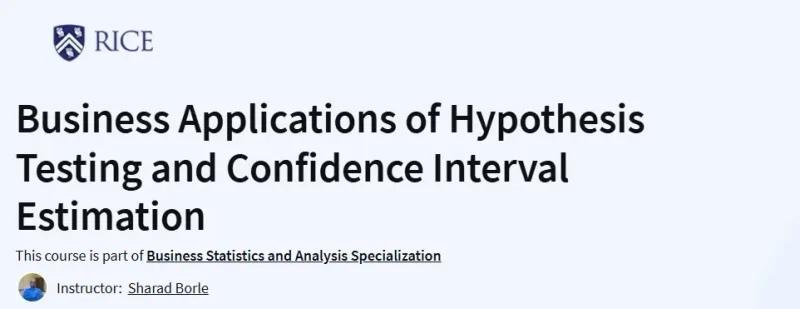
What will you in the Business Applications of Hypothesis Testing and Confidence Interval Estimation Course
-
Understand the fundamentals of confidence intervals and hypothesis testing
-
Apply statistical methods to real business problems using Microsoft Excel
-
Calculate the right sample size for surveys and testing scenarios
-
Differentiate between types of hypothesis tests and when to use them
-
Use Excel functions like T.DIST, T.INV, and Z.TEST for practical analysis
Program Overview
1. Confidence Interval – Introduction
Duration: 10 hours
-
Basics of confidence intervals, t-statistics, and z-scores
-
Use of Excel statistical functions like T.DIST and T.INV
-
Constructing confidence intervals using real-world datasets
2. Confidence Interval – Applications
Duration: 10 hours
-
Applying confidence intervals to business scenarios
-
Sample size calculations for product and service evaluation
-
Confidence intervals for proportions
-
Intro to hypothesis testing
3. Hypothesis Testing
Duration: 10 hours
-
Four steps for conducting a hypothesis test
-
Understanding null vs. alternative hypotheses
-
One-tailed vs. two-tailed tests
-
Type I and Type II errors
4. Hypothesis Test – Differences in Mean
Duration: 10 hours
-
Hypothesis testing on differences between two means
-
Equal and unequal variance conditions
-
Paired sample t-tests
-
Get certificate
Job Outlook
-
Business Analysts: Make decisions backed by statistical evidence
-
Data Analysts: Use hypothesis testing for actionable insights
-
Marketing Professionals: Measure campaign effectiveness through testing
-
Operations Managers: Analyze process improvements with statistical tools
-
Students: Build a solid base in business-focused statistics