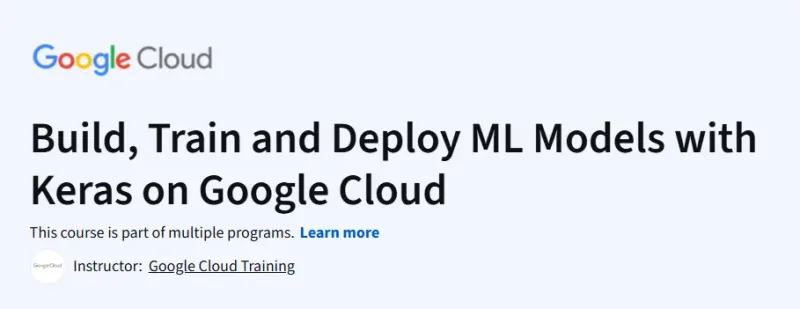
Build, Train and Deploy ML Models with Keras on Google Cloud Course

Build, Train and Deploy ML Models with Keras on Google Cloud Course Course

This course delivers a professional introduction to TensorFlow and Keras, balancing theory with hands-on labs. It’s ideal for developers aiming to step into AI, though follow-up courses are needed for...

Explore This Course
9.7/10 Highly Recommended

Build, Train and Deploy ML Models with Keras on Google Cloud Course on Coursera — This course delivers a professional introduction to TensorFlow and Keras, balancing theory with hands-on labs. It’s ideal for developers aiming to step into AI, though follow-up courses are needed for advanced structures like segmentation and distributed training.

Pros

  • High-quality instruction from Andrew Ng & DeepLearning.AI.
  • Well-structured hands-on labs using Colab, focusing on real-world ML workflows.
  • Strong learner satisfaction: 4.8★ rating from 19K+ students.

Cons

  • Intermediate-level prerequisites required (Python, basic ML concepts).
  • Limited to core content—advanced topics like GANs, distributed training, and deep segmentation are covered in subsequent specialization courses.

Build, Train and Deploy ML Models with Keras on Google Cloud Course Course

Platform: Coursera

What will you learn in Build, Train and Deploy ML Models with Keras on Google Cloud Course

  • Learn best practices for using TensorFlow to build scalable AI-powered models.

  • Construct and train basic neural networks, including feedforward and convolutional architectures for image recognition.

​​​​​​​​​​

  • Apply convolutions to improve network performance on computer vision tasks.

  • Work with Keras API for efficient model building, including Sequential API and its workflow.

Program Overview

Module 1: A New Programming Paradigm

⏳ ~5 hrs

  • Topics: Intro to ML/DL and TensorFlow’s programming paradigm. Includes discussion with Andrew Ng, neural network basics, and “Hello, World” neural nets.

  • Hands-on: TensorFlow setup and simple classification model coding in Python.

Module 2: The Sequential Model API

⏳ ~6 hrs

  • Topics: Build and train neural networks using the Keras Sequential API—cover layers, model compilation, fitting, evaluation, and prediction.

  • Hands-on: Build CNNs in Colab for MNIST digit classification.

Module 3: Validation, Regularization & Callbacks

⏳ ~6 hrs

  • Topics: Techniques to avoid overfitting, set up validation workflows, and use callbacks including EarlyStopping.

  • Hands-on: Train models on Iris dataset, tune with regularization, and practice callback mechanisms.

Module 4: Model Persistence & Advanced Structures

⏳ ~6 hrs

  • Topics: Save/load models, select weight-only vs full model saving, explore pretrained models. Also introduction to advanced architectures: CNNs, RNNs, transformers, and autoencoders.

  • Hands-on: Use Keras for advanced model building and application.

Get certificate

Job Outlook

  • Prepares you for roles like ML Engineer, TensorFlow Developer, and AI Software Engineer.

  • Serves as a stepping-stone for the DeepLearning.AI TensorFlow Developer Professional Certificate (3–6 months, ~4.7★ from 25K reviews).

Explore More Learning Paths

Elevate your machine learning expertise with these carefully selected courses, designed to help you master neural networks, Keras, and deep learning deployment on Google Cloud.

Related Courses

Related Reading

  • What Is Python Used For – Explore how Python powers machine learning, deep learning frameworks, and cloud-based model deployment.
FAQs

Do I need prior machine learning or Python experience to take this course?
Basic understanding of Python and introductory ML concepts is recommended. The course starts with TensorFlow setup and simple models for hands-on learning. Explains neural network fundamentals in an accessible way. Focuses on Keras Sequential API for model building. Suitable for learners with programming background looking to specialize in AI.
Will I learn to deploy models in real-world environments?
Covers model persistence (saving/loading) and deployment workflows. Demonstrates use of Keras models in cloud environments. Introduces best practices for production-ready ML pipelines. Emphasizes practical lab exercises with Colab and Google Cloud. Prepares learners for ML engineer or AI developer roles.
Does the course cover advanced architectures like CNNs and RNNs?
Introduces CNNs for image recognition and basic RNN concepts. Hands-on labs allow practice with feedforward and convolutional networks. Explains model tuning, regularization, and callback mechanisms. Advanced topics like transformers and autoencoders are briefly introduced. Serves as a foundation for deeper study in specialized AI courses.
Can non-technical managers benefit from this course?
Explains ML concepts and workflows in conceptual terms. Helps managers understand model design, training, and deployment processes. Supports strategic planning for AI-driven projects. Enhances communication with technical teams. Provides a framework for evaluating ML initiatives in organizations.
How does this course differ from general TensorFlow courses?
Focuses specifically on Keras API and high-level model building. Balances theory with hands-on lab-driven exercises. Emphasizes cloud-based deployment with Google Cloud integration. Includes practical exercises for CNNs and Sequential models. Provides a clear path toward AI developer roles and DeepLearning.AI certifications.

Similar Courses

Other courses in Data Science Courses