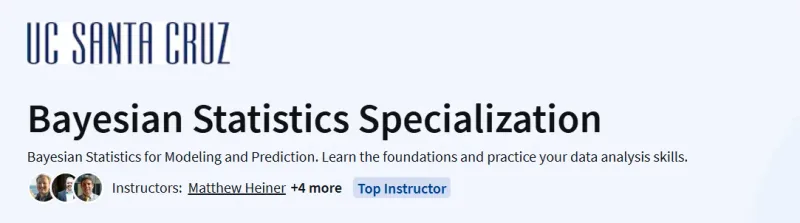
What will you learn in this Bayesian Statistics Specialization Course
-
Bayesian Foundations: Grasp the core principles of Bayesian statistics, including probability theory, Bayes’ theorem, and the philosophical differences between Bayesian and frequentist approaches.
-
Advanced Modeling Techniques: Delve into complex models such as mixture models and dynamic linear models, enhancing your ability to model real-world data scenarios.
-
Markov Chain Monte Carlo (MCMC): Learn computational techniques like MCMC to perform Bayesian inference when analytical solutions are intractable.
-
Time Series Analysis: Apply Bayesian methods to time-dependent data, enabling forecasting and understanding of temporal patterns.
-
Practical Application with R: Gain hands-on experience using R programming for Bayesian data analysis, reinforcing theoretical knowledge through practical exercises.
Program Overview
1. Bayesian Statistics: From Concept to Data Analysis
⏳ 11 hours
-
Introduction to Bayesian thinking and probability.
-
Comparison between Bayesian and frequentist methods.
-
Basic data analysis using R
2. Bayesian Statistics: Techniques and Models
⏳ 29 hours
-
Exploration of advanced models and computational techniques.
-
Implementation of MCMC methods using R and JAGS.
-
Application to various data types including continuous, binary, and count data.
3. Bayesian Statistics: Mixture Models
⏳ 21 hours
-
Understanding and applying mixture models.
-
Techniques for model fitting and assessment.
-
Use of R for practical implementation.
4. Bayesian Statistics: Time Series Analysis
⏳ 22 hours
-
Modeling temporal dependencies in data.
-
Forecasting using dynamic linear models.
-
Hands-on projects with real-world time series data.
5. Bayesian Statistics: Capstone Project
⏳ 12 hours
-
Integration of knowledge from previous courses.
-
Comprehensive data analysis project using Bayesian methods.
-
Presentation of findings in a professional report format.
Get certificate
Job Outlook
-
The demand for professionals skilled in Bayesian statistics is growing across industries such as finance, healthcare, and technology.
-
Proficiency in Bayesian methods enhances roles in data science, machine learning, and statistical analysis.
-
Employers value the ability to handle uncertainty and make probabilistic inferences, skills central to Bayesian analysis.
Explore More Learning Paths
Deepen your statistical expertise with these carefully selected programs designed to strengthen your understanding of Bayesian methods, data analysis, and Python-based statistical modeling.
Related Courses
-
Bayesian Statistics: From Concept to Data Analysis Course – Learn Bayesian principles and how to apply them to real-world data analysis scenarios using practical examples.
-
Statistics with Python Specialization Course – Build statistical modeling and data analysis skills with Python to analyze datasets and interpret results effectively.
Related Reading
-
What Is Data Management? – Understand how proper data management practices are crucial for accurate statistical analysis, modeling, and decision-making.