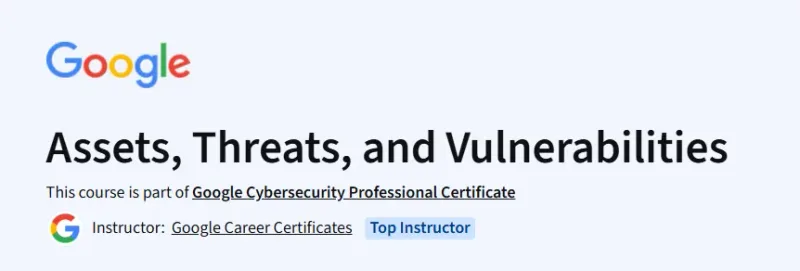
What will you learn in Assets, Threats, and Vulnerabilities Course
-
Classify organizational assets by type and sensitivity to prioritize security efforts.
-
Analyze attack surfaces to identify risks and potential exposure points.
-
Recognize common threats such as social engineering, malware, and web-based exploits.
-
Adopt a threat actor’s mindset and apply threat modeling techniques.
-
Understand vulnerability management, including assessment and remediation strategies.
Program Overview
Module 1: Introduction to Asset Security
⏳ ~3 hours
-
Topics: Asset classification; NIST Cybersecurity Framework; differentiating physical vs. digital assets.
-
Hands-on: Assignments on inventorying assets and mapping critical resources.
Module 2: Protecting Organizational Assets
⏳ ~4 hours
-
Topics: Implementing security controls like encryption, hashing; exploring authentication vs. authorization techniques.
-
Hands-on: Embedded labs and quizzes on control selection and implementation.
Module 3: Vulnerabilities in Systems
⏳ ~4 hours
-
Topics: Vulnerability life-cycle and management; understanding CVEs and the MITRE ATT&CK framework.
-
Hands-on: Case-based exercises simulating vulnerability discovery and mitigation.
Module 4: Threats to Asset Security
⏳ ~4 hours
-
Topics: Examining malware, phishing, social engineering, and other threat vectors; threat modeling principles.
-
Hands-on: Practical labs following a threat modeling methodology.
Get certificate
Job Outlook
-
Equips learners for roles such as Cybersecurity Analyst, SOC Tier 1, Vulnerability Analyst, or Information Security Specialist.
-
Reinforces essential skills for pursuing CompTIA Security+, CCNA Security, and Google Cybersecurity certifications.
Explore More Learning Paths
Strengthen your understanding of digital and financial risks with these curated courses, designed to help you identify assets, assess threats, and manage vulnerabilities in both technology and business contexts.
Related Courses
-
Decentralized Finance (DeFi) Infrastructure Course – Learn how decentralized finance systems work and the potential risks and vulnerabilities inherent in DeFi infrastructure.
-
Financial Technology (FinTech) Innovations Specialization Course – Explore innovative financial technologies and understand the security considerations needed to protect digital assets.
-
Finance for Non-Finance Professionals Course – Gain essential financial literacy to better assess organizational assets and potential vulnerabilities.
Related Reading
-
What Is Risk Management – Understand strategies to identify, analyze, and mitigate risks in both business and technical environments.