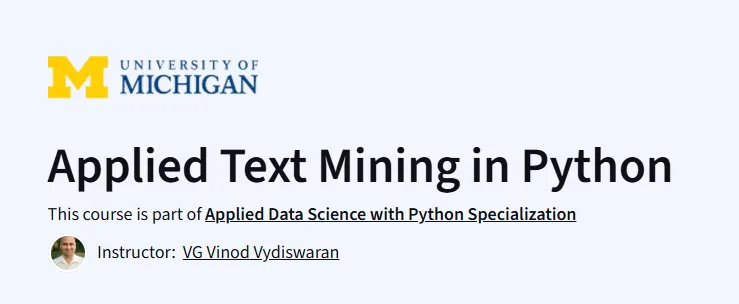
What will you learn in Applied Text Mining in Python Course
- Clean and preprocess raw text using regular expressions and normalization techniques.
- Understand how text is represented and manipulated in Python, including encoding and tokenization.
- Leverage the NLTK framework for common natural language processing tasks such as part-of-speech tagging and feature extraction.
- Build supervised text classification pipelines to categorize documents and perform sentiment analysis.
- Implement topic modeling methods to discover themes and group similar documents.
Program Overview
Module 1: Working with Text in Python
⌛ 1 week
- Topics: Reading text files, interpreting UTF-8 encoding, tokenization into words and sentences, addressing common issues in unstructured text, writing regular expressions for pattern matching.
- Hands-on: Clean sample text files, extract dates and patterns using regex.
Module 2: Basic Natural Language Processing
⌛ 1 week
- Topics: Introduction to NLTK toolkit, tokenization, stemming, lemmatization, part-of-speech tagging, stop-word removal, feature derivation from text.
- Hands-on: Process raw text through NLTK, tag language constructs, and derive meaningful features for analysis.
Module 3: Text Classification and Supervised Learning
⌛ 1 week
- Topics: Converting text to numerical representations, training and evaluating classifiers (e.g., Naive Bayes), handling imbalanced datasets.
- Hands-on: Build and test a document classification model to automatically categorize news articles.
Module 4: Topic Modeling and Document Similarity
⌛ 1 week
- Topics: Probabilistic topic models (LDA), vector space representations, cosine similarity, clustering documents by theme.
- Hands-on: Apply LDA to discover latent topics in a corpus and group documents based on similarity metrics.
Get certificate
Job Outlook
- Roles like NLP Engineer, Data Scientist, and Text Analytics Specialist often require strong text preprocessing and modeling expertise.
-
- Demand for professionals skilled in text mining and NLP is rapidly growing across sectors such as technology, finance, healthcare, and media.
- Opportunities span research labs, startups, and large enterprises focused on unstructured data analysis.
Explore More Learning Paths
Deepen your expertise in extracting insights from unstructured text by exploring courses that strengthen your data mining skills, enhance analytical thinking, and introduce advanced process-level analysis techniques.
Related Courses
1. Data Mining Specialization Course
Learn core data mining techniques such as clustering, classification, and pattern discovery—skills that complement advanced text mining workflows.
2. Process Mining: Data Science in Action Course
Discover how to analyze event logs, map real business processes, and uncover operational inefficiencies through data-driven process insights.
Related Reading
What Is Data Management?
A foundational overview of how data is collected, organized, and governed—essential knowledge for managing large text datasets effectively.