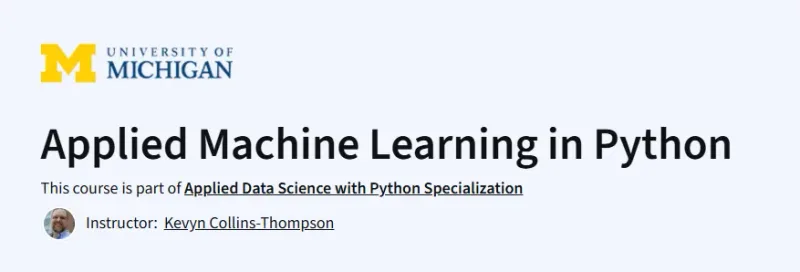
What will you learn in Applied Machine Learning in Python Course
-
Build and evaluate supervised and unsupervised models using scikit‑learn (e.g. decision trees, random forests, regression, K‑means clustering).
-
Understand techniques for model validation, overfitting prevention, cross-validation, feature engineering, and boosting methods.
-
Learn to apply ensemble methods to improve predictive accuracy and solve classification/regression tasks.
-
Gain practical workflows for machine learning projects—from dataset preparation through model tuning to evaluation.
Program Overview
Module 1: Fundamentals of Machine Learning
Duration: ~6 hours
-
Topics: ML lifecycle, supervised vs unsupervised learning, intro to scikit‑learn
-
Hands-on: Build K‑nearest neighbors and linear regression models on example datasets
Module 2: Decision Trees & Random Forests
Duration: ~1 week
-
Topics: Tree-based models for classification and regression, feature importance
-
Hands-on: Train and evaluate random forest models with cross-validation
Module 3: Clustering & Feature Engineering
Duration: ~1 week
-
Topics: K‑means clustering, dimensionality issues, feature scaling
-
Hands‑on: Cluster unlabeled data and improve performance with engineered features
Module 4: Ensemble Methods & Model Optimization
Duration: ~1 week
-
Topics: Gradient boosting, bagging, overfitting mitigation, hyperparameter tuning
-
Hands-on: Apply boosting techniques and cross-validated grid search for model improvement
Get certificate
Job Outlook
-
High demand for machine learning skills in roles like ML Engineer, Data Scientist, and Predictive Analytics Specialist
-
Applicable across industries—tech, finance, healthcare, marketing—with salaries from $80K–$150K+
-
Frequent hiring value for experience with Python, scikit‑learn, and real-world project workflows
-
Useful for freelance ML projects, startup technical roles, or building portfolio pieces for career switchers
Explore More Learning Paths
Take your machine learning skills even further with these curated learning paths. Each recommended course builds on your foundation in Python-based ML—helping you advance toward more complex models, cloud-scale deployment, and real-world ML applications.
Related Courses
1. Advanced Machine Learning on Google Cloud Specialization Course
Learn to design, build, and deploy scalable machine learning models on Google Cloud using advanced tools and real-world MLOps practices.
2. Machine Learning with Python Course
Strengthen your understanding of supervised and unsupervised learning, model evaluation, and Python-based ML workflows.
3. A Practical Guide to Machine Learning with Python Course
Apply ML concepts through hands-on exercises that teach practical implementation, optimization, and troubleshooting of Python ML models.
Related Reading
What Is Data Management?
A foundational guide explaining how data is collected, stored, organized, and governed—knowledge that’s essential for successful ML projects.