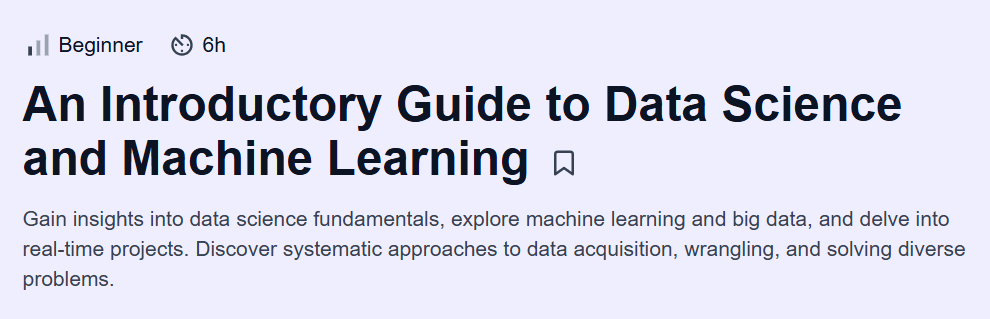
What will you learn in An Introductory Guide to Data Science and Machine Learning Course
-
Core data science pipeline: Explore data acquisition (e.g., web scraping), data wrangling, and visualization using Numpy, Pandas, Seaborn, and SpaCy.
-
Foundations of probability & statistics: Understand distributions, hypothesis testing, Bayes’ theorem, sampling methods, and descriptive statistics.
-
Machine learning essentials: Cover regression (linear, multivariate, support vector), classification (SVM, Naive Bayes, ensembles), feature engineering, model evaluation, and hyperparameter tuning.
-
Unsupervised learning & dimensionality reduction: Dive into clustering techniques (K‑Means, DBSCAN, hierarchical, PCA) and association rule mining.
-
Deep learning and Big Data overview: Learn key neural network architectures (CNN, RNN, LSTM) and explore big data tools like Hadoop and Spark.
Program Overview
Module 1: Introduction to Data Science
⏳ ~30 minutes
-
Topics: Differentiate data science vs. analysis and engineering, lifecycle phases, data structures.
-
Hands-on: Complete a quiz and reflective exercise on industry use cases.
Module 2: Applications of Data Science
⏳ ~30 minutes
-
Topics: Practical applications in healthcare, recommendation systems, and image analysis.
-
Hands-on: Examine real-world datasets and build a miniature recommender prototype.
Module 3: Essential Libraries
⏳ ~2 hours
-
Topics: Web scraping (BeautifulSoup, Scrapy), array ops (NumPy), dataframes (Pandas), NLP basics (SpaCy), visualization (Seaborn).
-
Hands-on: Extract, transform, explore data from HTML sources, and create visual insights.
Module 4: Probability & Statistics
⏳ ~2 hours
-
Topics: Distributions, Bayes’ theorem, measures of central tendency/dispersion, hypothesis testing.
-
Hands-on: Analyze sample datasets, compute probabilities, and conduct t‑tests with quizzes.
Module 5: Machine Learning Part I
⏳ ~3 hours
-
Topics: Regression models, feature engineering, scaling, model evaluation, regularization.
-
Hands-on: Solve a house-price prediction challenge using scikit-learn pipelines.
Module 6: Machine Learning Part II
⏳ ~2.5 hours
-
Topics: Classification algorithms, ensemble methods, imbalance handling, hyperparameter optimization.
-
Hands-on: Build and evaluate classifiers, improve model performance for imbalanced data.
Module 7: Machine Learning Part III & Unsupervised Methods
⏳ ~2 hours
-
Topics: Clustering (K‑means, hierarchical, DBSCAN), Apriori for association rules, and PCA.
-
Hands-on: Segment customers, mine associations, and reduce dimensionality in datasets.
Module 8: Deep Learning Essentials
⏳ ~1.5 hours
-
Topics: Neural network basics, CNNs, RNNs, LSTMs, and backpropagation.
-
Hands-on: Build a simple neural network for image or sequence tasks.
Module 9: ML Tools & Big Data
⏳ ~1 hour
-
Topics: Automl (PyCaret), GPU acceleration (RAPIDS), Hadoop ecosystem, Apache Spark.
-
Hands-on: Run a Pandas profiling analysis and spin up a Spark task.
Module 10: Next Steps & Projects
⏳ ~30 minutes
-
Topics: Resources for Kaggle, project pathways, and further learning.
-
Hands-on: Plan a capstone project roadmap using course insights.
Get certificate
Job Outlook
-
High-impact skillset: Equips learners for roles as Data Analysts, Business Analysts, Junior Data Scientists, or ML Engineers.
-
Broad applicability across sectors: Essential in healthcare, finance, tech, retail, image analytics, and recommendation systems.
-
Foundation for advanced learning: Preps for deeper study in ML, deep learning, big data, and professional certifications.
-
Industry credential: Educative’s project-based, code-first format builds work-ready skills and portfolio examples.
Explore More Learning Paths
Enhance your data science and machine learning skills with these related courses and resources. These learning paths will help you build a strong foundation, apply practical techniques, and advance your career in data-driven fields.
Related Courses
-
Data Science and Machine Learning Internship Program
Gain hands-on experience in data science and machine learning through a practical internship program that applies real-world scenarios. -
Data Science, Statistics, and Machine Learning Specialization
Build a solid understanding of statistical analysis and machine learning techniques essential for data-driven decision-making. -
Linear Algebra for Machine Learning and Data Science
Learn the mathematical foundations necessary for machine learning algorithms and data science applications.
Related Reading
-
What Is Python Used For
Discover how Python is extensively used in data science and machine learning for coding, analysis, and model development.